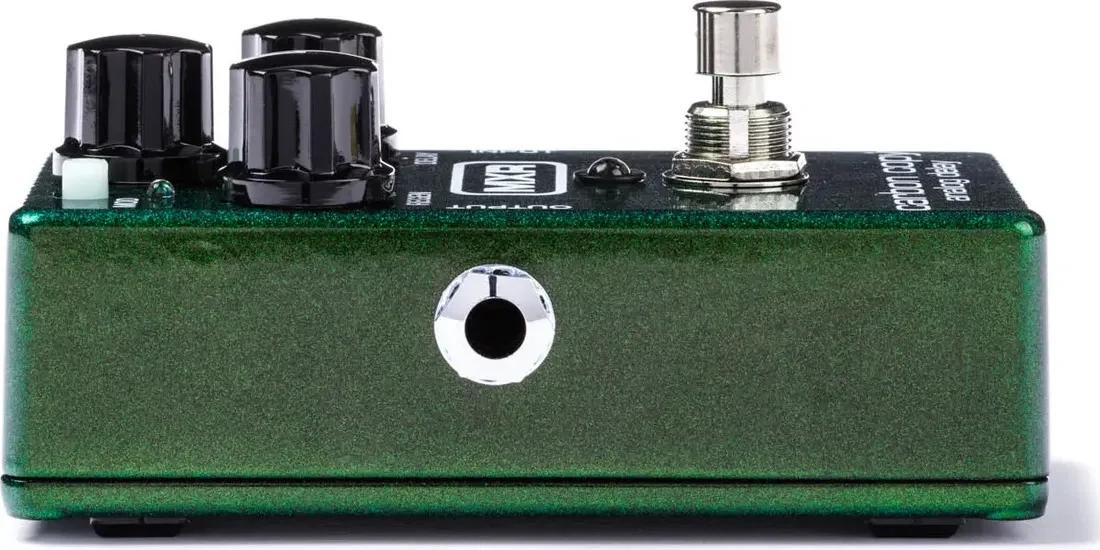
Up to 600 ms of warm echo that stays out of the guitar's way
The Carbon Copy's repeats are warm and dark, losing treble as they fade, so the echo sits behind the dry guitar instead of competing with it. That suits slapback, a soft echo under solos or a wash behind clean chords. It gives between 20 and 600 ms of delay, and MusicRadar pointed out that 600 ms is long for the type: many analogue delays, old and new, stop at about half that.
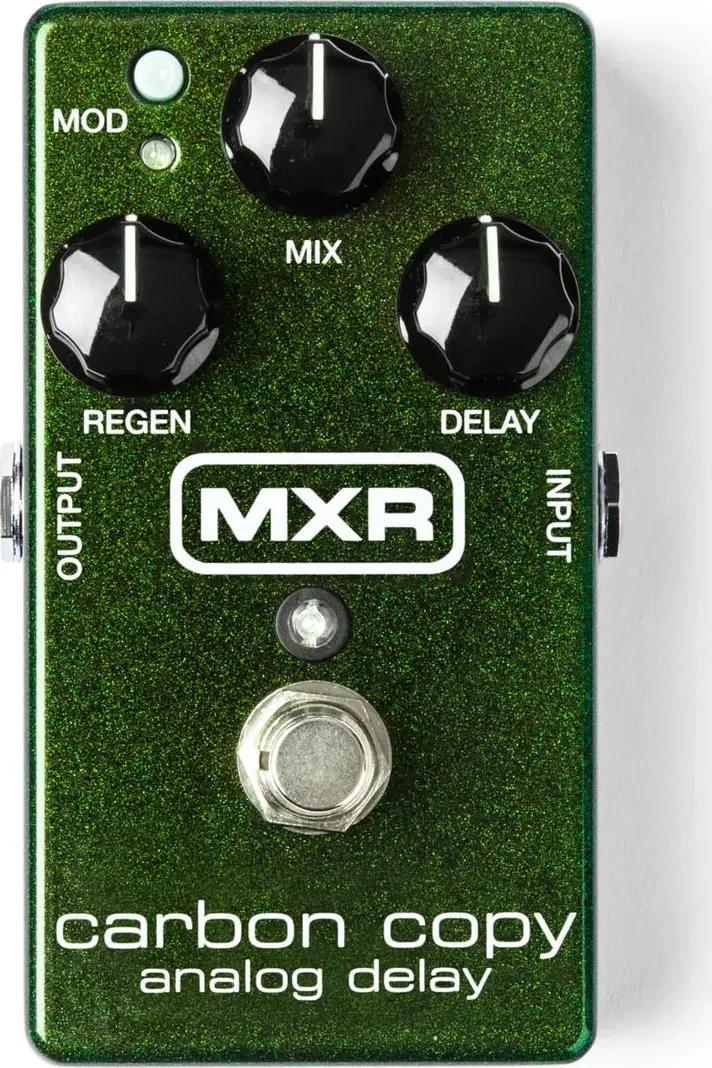
Three knobs do the work. Delay sets the time, Regen the number of repeats and Mix the balance of echo and dry signal. A small Mod button adds a slow pitch wobble to the repeats, and two trim pots inside the pedal set how wide and how fast that wobble is. The bypass is true bypass, the pedal is mono, and it runs on a 9V battery or adaptor, drawing 26 mA.
Clear, warm and useful from slapback to ambient
The published reviews agree on that character. MusicRadar called the result clear but darkly warm, with a natural decay, and useful from short, springy settings through slapback to ambient delay. Premier Guitar rated it among the most musical analogue delays its reviewer had tried and noted that long settings keep their tone. Thomann owners say much the same, and "warm" is the word they reach for most.
With Regen turned up past the middle the pedal feeds back on itself, which MusicRadar recommended for dub and spacey effects. The modulation is subtle as it leaves the factory; turned up at the trim pots, it gives the repeats the warble of a tape echo.
Where the darkness counts against it
Bonedo's review is the dissenting one. Its tester found the delay sound dull next to Electro-Harmonix's Memory Man, and judged that at longer times the repeats blur into a cloud. That suits a soft echo behind a solo, but not tight, rhythmic delay parts where each repeat has to be heard. A couple of owners make the same point, one finding it muddy with some amps and pedals. Two of the 30 Thomann reviews read for this page were written by buyers who sent the pedal back, one over the dark tone and one over hiss.
The other complaints are practical. There is no tap tempo, so the delay time is set by ear. The modulation trim pots are tiny and sit inside the pedal, and the battery is behind the base plate; MusicRadar listed both as its only negatives, and suggested setting the trim pots once and leaving them.
MXR's standard analogue delay since 2008
The Carbon Copy, model M169, is MXR's standard analogue delay, launched in 2008. Its audio path is entirely analogue and built on bucket-brigade chips, and MusicRadar's review saw it as a nod to MXR's own green Analog Delay of the 1980s. MXR has since built a family around it, including the Carbon Copy Mini, the Carbon Copy Bright and the larger Carbon Copy Deluxe, which doubles the delay time and adds tap tempo. This review covers the original.
Who it suits and what to compare it with
The Carbon Copy suits players who want delay as atmosphere: slapback, a soft echo under solos, or a wash behind clean chords. Like most delays it normally goes after a drive pedal such as the Ibanez TS9 Tube Screamer, and one Thomann owner advises keeping it out of the front of a saturated amp channel.
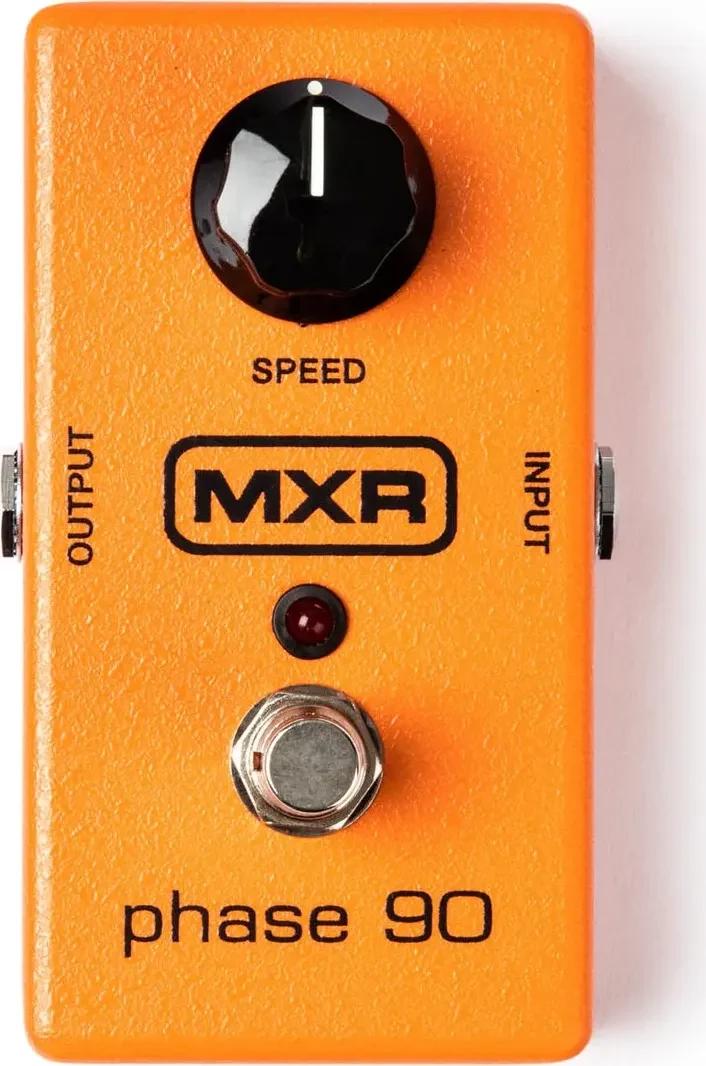
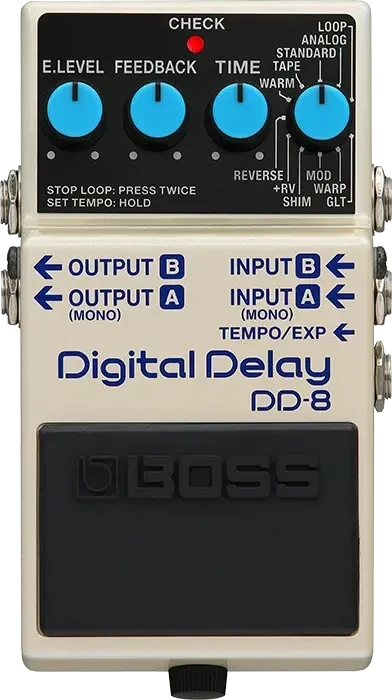
The obvious alternative is the Boss DD-8, its digital counterpart. The Boss gives clean, exact repeats, far longer delay times, stereo, a looper and an analogue-style mode, and it takes an external tap tempo switch; the MXR does one sound, and that sound is the reason to buy it. For reverb in place of echo, see the TC Electronic Hall of Fame 2, and for the other MXR pedal that turns up on as many boards, the Phase 90.