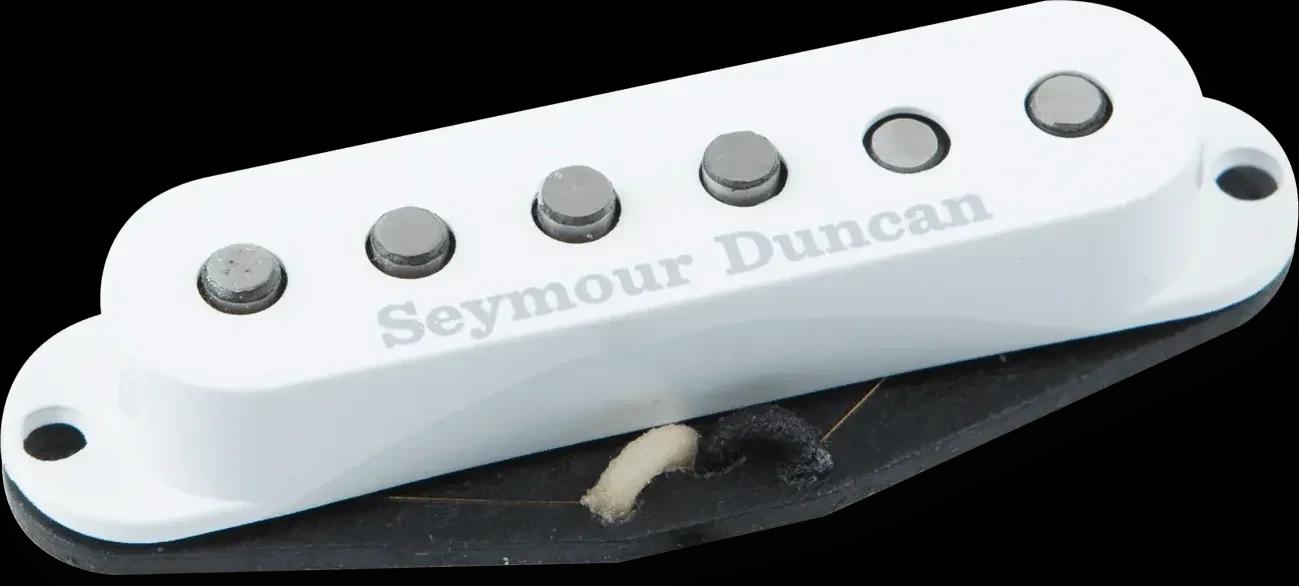
The standard Stratocaster circuit has three single-coil pickups, a five-way switch, one volume, two tone controls and one capacitor. It has barely changed since the five-way switch became standard, and once you understand it, almost every Strat mod is a small change to it.
This guide sets out every connection in a diagram and in tables, with a suggested order of work.
How the five-way switch works
The Strat switch has two separate poles, which Seymour Duncan labels A and B. Each pole has a common lug (A0 and B0) and three lugs that the switch connects to the common in turn (A1 to A3 and B1 to B3). In the in-between positions the switch's contact bridges two adjacent lugs at once, which is how two pickups end up connected together.
- Pole A selects the pickups. Each pickup's hot goes to its own lug.
- Pole B selects the tone controls. Each tone control goes to the lug matching its pickup.
- A jumper joins A0 to B0, and the volume control takes its signal from that joined pair.
| Position | Pickups on | Tone control in circuit (standard) |
|---|---|---|
| 1 (nearest the bridge) | Bridge | None |
| 2 | Bridge and middle | Tone 2 |
| 3 | Middle | Tone 2 |
| 4 | Middle and neck | Tone 1 and tone 2 |
| 5 (nearest the neck) | Neck | Tone 1 |
Makers lay out and label the lugs differently. Identify A0, B0 and the position lugs on your own switch with a multimeter, or from its maker's sheet, before you solder.
What the middle pickup on a Strat is for
On its own, in position 3, the middle pickup sits between the neck and bridge pickups, and so between their sounds; how guitar pickups work explains why position changes tone. Seymour Duncan notes that position 3 is not the most popular setting, though players such as Eric Clapton and Stevie Ray Vaughan have used it.
Its bigger job is in the in-between positions. Paired with the bridge pickup in position 2 and the neck pickup in position 4, it gives the combined sounds Guitar World credits Jimi Hendrix with popularising, and Seymour Duncan calls position 4 one of the most used Strat settings. Guitar World also notes that until 1977 Strat players had to balance the three-way switch between positions by hand to get those sounds.
The middle pickup is also what keeps positions 2 and 4 quiet. Seymour Duncan makes a reverse-wound, reverse-polarity middle version of its SSL-1 for this purpose: paired with a standard neck or bridge pickup, the two cancel hum like a humbucker. On its own, in position 3, it hums like any single coil.
Parts list
| Part | Value or type | Note |
|---|---|---|
| Single-coil pickups | 3 | A reverse-wound, reverse-polarity middle pickup makes positions 2 and 4 hum-cancelling |
| Five-way switch | Two-pole Strat type | Lug layout varies by maker |
| Volume pot | 250k, audio taper | 250k is the usual value for single coils |
| Tone pots | 2 × 250k | Tone 1 sits next to the volume |
| Tone capacitor | One, commonly 0.022 µF or 0.047 µF | DiMarzio's Strat harness uses 0.022 µF; StewMac's standard kit uses 0.047 µF |
| Output jack | Mono | Fits the Strat's recessed jack plate |
| Hook-up wire | Two colours | Use one colour for hot, one for ground |
| Ground wire to the vibrato claw | One length | Runs through the body to the claw |
The 250k vs 500k pots guide explains why single coils use 250k.
Wire colours by maker
Each pickup has a hot and a ground lead. Seymour Duncan's colour code for its single coils is white (or yellow on some models) for hot and black for ground. Fender and DiMarzio use different colours across their ranges and generations, so read the sheet that comes with the pickup, or check with a multimeter. If you are fitting single-coil-sized humbuckers instead, Seymour Duncan's code is black hot, red and white joined, green and bare to ground.
Safety and soldering
Work in a ventilated room, keep the iron in its stand when it is not in your hand, and wash your hands after using lead-based solder. Make each joint quickly: heat the lug and wire together, add solder until it flows, and lift the iron away. Long heating on a pot casing can damage the pot. Protect the guitar's finish and pickguard from the hot tip.
Connections
| # | From | To | Note |
|---|---|---|---|
| 1 | Bridge pickup hot | Switch A1 | |
| 2 | Middle pickup hot | Switch A2 | |
| 3 | Neck pickup hot | Switch A3 | |
| 4 | Switch A0 | Switch B0 | Short jumper between the two commons |
| 5 | Switch B0 | Volume pot, input outer lug | Signal from the switch |
| 6 | Volume pot, centre lug | Output jack, tip | Signal out |
| 7 | Volume pot, remaining outer lug | Volume pot casing | Ground |
| 8 | Switch B3 | Tone 1 pot, centre lug | Neck tone |
| 9 | Switch B2 | Tone 2 pot, centre lug | Middle tone |
| 10 | Tone 1 pot, outer lug | Capacitor, one leg | |
| 11 | Capacitor, other leg | Tone pot casing (ground) | |
| 12 | Tone 2 pot, matching outer lug | Tone 1 pot, the capacitor's lug | Both tones share one capacitor |
| 13 | All three pickup grounds | Volume pot casing | Or a ground bus |
| 14 | Output jack, sleeve | Volume pot casing | Ground |
| 15 | Vibrato claw ground wire | Volume pot casing | Grounds the strings |
| 16 | Pot casings | Each other | A bare wire linking all three pot backs |
Switch B1 is left empty in standard wiring, which is why the bridge pickup has no tone control.
Order of work: wire the pots and capacitor first, then the switch, then the jack, and the pickups last. That way the pickup leads are not in the way while you work on the rest.
The bridge tone variation
Many players want a tone control on the bridge pickup, which is often the brightest. The usual change is one short jumper:
| From | To | Result |
|---|---|---|
| Switch B1 | Switch B2 | Tone 2 now controls the bridge and middle pickups |
Tone 1 still controls the neck. This layout, with a neck tone and a combined bridge-and-middle tone, is common on modern Strat-style guitars.
Test before you close it up
With the strings off or slack, plug in at low volume and tap each pickup's pole pieces with a steel screwdriver in every switch position. Each position should give the pickups in the table above. Turn each tone control and check it works in the positions it should. If a position is silent, check the switch lug for that position first.
Then refit the pickguard, restring and set the pickup heights.
Where to go next
- Neck and bridge together, or all three: the seven-sound Strat mod adds them with one switch.
- A new set of pickups: see the best Stratocaster pickups guide.
- First time replacing a pickup: read how to change a pickup.
- A Telecaster instead: the Telecaster wiring diagram covers its three-way switch connection by connection.
- More circuits: the Wiring hub collects every wiring guide on the site.