The rule most players learn is simple: 250k pots for single coils, 500k for humbuckers. It is a good rule, and it is worth knowing why it exists, because the same reasoning tells you when to break it. The pot value is one of the cheapest and most effective ways to adjust how bright a guitar sounds.
A pot is a variable resistor with three lugs
A potentiometer, or pot, is a resistive track with a wiper that moves along it as you turn the shaft. It has three lugs: one at each end of the track and the wiper in the middle. The value printed on it, such as 250k or 500k, is the total resistance between the two outer lugs, in kilohms.
In a volume control the pickup's signal goes to one outer lug, the other outer lug goes to ground and the wiper feeds the output jack. Turning the knob changes how much of the signal reaches the jack and how much is sent to ground. In a tone control the pot is wired in series with a capacitor to ground, so turning it down lets more treble drain away through the capacitor.
The pot value sets how much treble leaks away
Even with both knobs on full, the pots are still connected between the signal and ground. That means some of the pickup's signal is always leaking through them, and the high frequencies leak most easily. A passive pickup has a resonant peak, a point where its response rises before the treble falls away, and the pots act as a load that pulls that peak down and flattens it.
Seymour Duncan's explanation of the effect is that a lower value attenuates the high frequencies harder, while a higher value disturbs them less. So:
- A 250k pot drains more treble. StewMac describes it as slightly warmer than a 500k, because it bleeds some highs to ground.
- A 500k pot drains less treble, so the guitar sounds brighter and a little more open.
- A 1 meg pot drains less still. Seymour Duncan lists it for Jazzmasters, some Telecasters and some active pickups.
The total load the pickup sees includes every pot connected to it at the time. Two 500k pots in parallel load the pickup like a single 250k pot, which is simple Ohm's law. Seymour Duncan notes that some wiring schemes make a 500k pot behave like a 250k depending on the switch position, which is one way builders get both values in one guitar.
Why single coils get 250k and humbuckers 500k
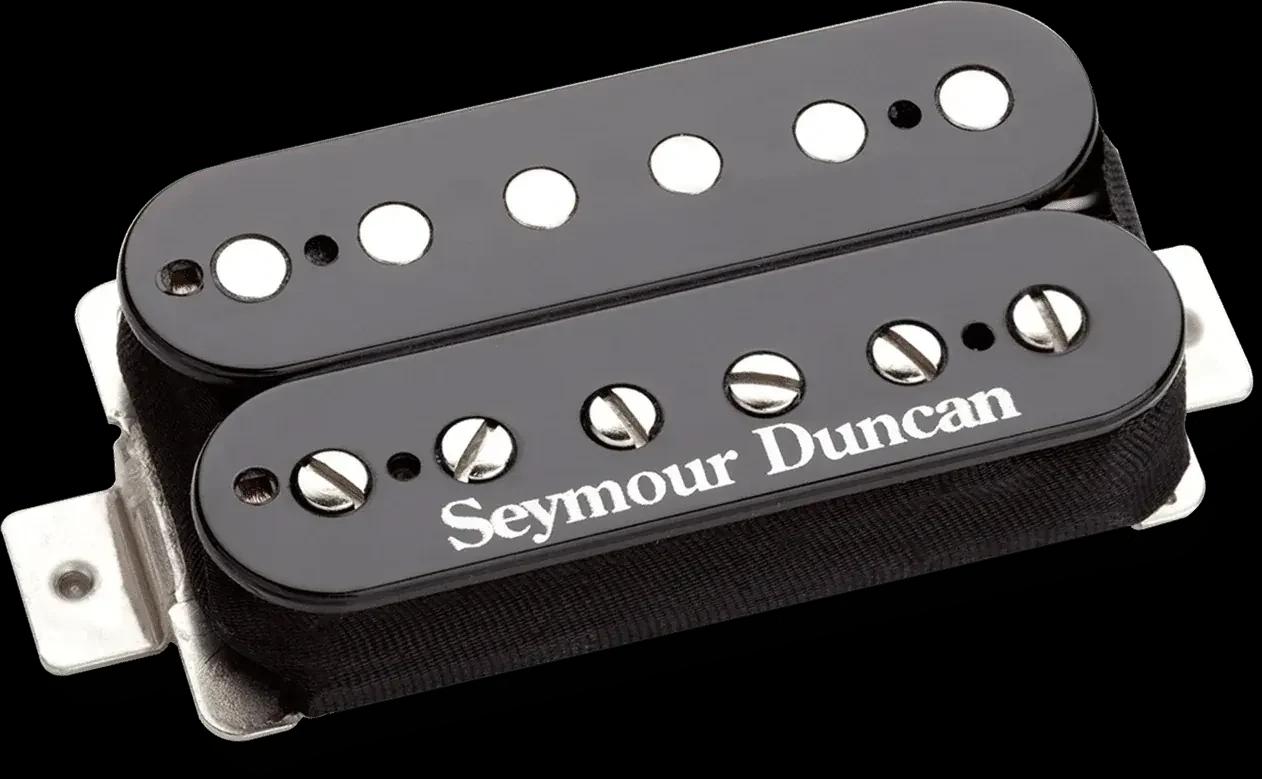
Single coils are bright to begin with, because they have small coils with relatively little inductance. Seymour Duncan's explanation is that the makers chose 250k pots to tame that brightness. Humbuckers have two coils and more inductance, which already rolls off a lot of treble, so a 500k pot keeps them from sounding muddy.
That gives you the traditional pairings:
| Pickups | Usual pot value | Why |
|---|---|---|
| Single coils (Strat, Tele, P-90) | 250k | Softens a bright pickup |
| Humbuckers | 500k | Keeps a darker pickup clear |
| Jazzmaster, some Telecasters | 1 meg | Maximum brightness |
| Active pickups | 25k (or 100k) | Matches the preamp's low-impedance output |
The rule is there to be broken
Seymour Duncan says plainly that these are not hard and fast rules, and DiMarzio's FAQ agrees that pot value is a matter of taste; mixing values is safe for both pickups and amps.
- A dull Strat or Tele: try 500k pots for more top end and a little more apparent output.
- A harsh humbucker: try 250k pots for a warmer sound. Seymour Duncan's own example is the JB: it says the JB was originally designed with 250k pots in mind, which is why some players find it bright in guitars with 500k, and the JB's product page notes that a 250k pot softens it.
- A guitar with both types (HSS or HSH): Seymour Duncan says most makers fit 500k pots to these combinations. Alternatives are separate volume pots for each pickup type, or a switching scheme that changes the load.
- A middle ground: wire a resistor across a 500k pot to lower its effective value. Seymour Duncan describes soldering a 500k resistor across a 500k pot to make it behave like a 250k.
Taper, tolerance and shaft type matter too
Taper describes how the resistance changes as the knob turns. An audio (logarithmic) taper changes slowly at first and quickly towards the end, which matches how the ear judges loudness. A linear taper changes evenly. Most guitar volume and tone pots are audio taper, and the CTS pots sold by StewMac are described as precision audio taper.
Tolerance is how far the real value can differ from the label. StewMac lists ±10 per cent for its CTS pots, so a "500k" pot may measure anywhere from 450k to 550k. Some players measure a batch and pick the highest-reading pots.
Shaft and bushing decide what knobs fit and what holes the pot needs. StewMac's CTS range comes with split knurled shafts for push-on knobs, solid shafts for set-screw knobs and a long split shaft for carved-top guitars such as a Les Paul, all on a 3/8-inch thread. Many imported guitars use smaller metric pots instead. The guide to guitar control knobs explains shaft types and which knobs fit each.
Tone capacitors work with the pot
The tone pot's capacitor decides which frequencies are cut as you turn it down. Seymour Duncan's guide gives these common values:
- 0.015 µF: fine treble control across the whole sweep.
- 0.022 µF: the middle ground, suitable for single coils and humbuckers alike, and the one to start with if you are unsure.
- 0.047 µF: darker, often used in bright guitars such as Strats and Teles and in some jazz humbucker guitars.
A larger capacitor cuts more treble as the knob turns down. With the tone knob on full, the capacitor has little effect; the pot's resistance is what the pickup sees.
Rolling down the volume costs treble
A volume pot is a resistive load, so as you turn it down the guitar sounds darker as well as quieter. Many players fit a treble bleed, a small capacitor (sometimes with a resistor) across two lugs of the volume pot, which lets some high frequencies bypass the pot as it turns down. Opinions on whether it improves the sound differ, so it is worth trying in your own guitar.
Changing a pot is a simple soldering job
To replace one, note where each wire goes, desolder, fit the new pot with its washer and nut, and resolder the same connections, including the ground to the pot's case. The wiring tutorials show complete circuits, including the Stratocaster 5-way switch, Les Paul '50s and modern wiring and push-pull coil splitting, which needs a push-pull pot of the right value. The Parts hub collects the other guides to the components inside a guitar.
For more on why pickups and pots interact the way they do, see pickup specifications explained, single coil pickups explained and humbuckers explained.