A guitar pickup is the part of an electric guitar that turns the vibration of the strings into an electrical signal the amplifier can use. It is not a microphone. A magnetic pickup is a magnet wrapped in a coil of very fine copper wire, sitting a few millimetres under the strings, and an electric guitar has one or more of them. Everything about the way an electric guitar sounds starts with what happens in that small gap.
The string disturbs a magnetic field
The magnet in a pickup magnetises the part of each steel string that sits above it. When you pluck the string, that magnetised section moves back and forth through the pickup's field and the amount of magnetic flux passing through the coil rises and falls in step with it.
A changing magnetic field passing through a coil of wire induces a voltage in that wire. This is electromagnetic induction, the same principle that lets a generator make electricity, and it is described by Faraday's law. The faster the flux changes and the more turns of wire it passes through, the larger the voltage. The result is a small alternating signal that follows the string's movement, which the guitar cable carries to the amplifier.
Two things follow from this. A pickup only hears strings that can be magnetised, so nylon strings make no signal at all. And a pickup hears the string, not the body: the wood and construction of the guitar matter only in so far as they change how the string vibrates.
The parts of a pickup and what each does
Every magnetic pickup has the same few ingredients, arranged in different ways.
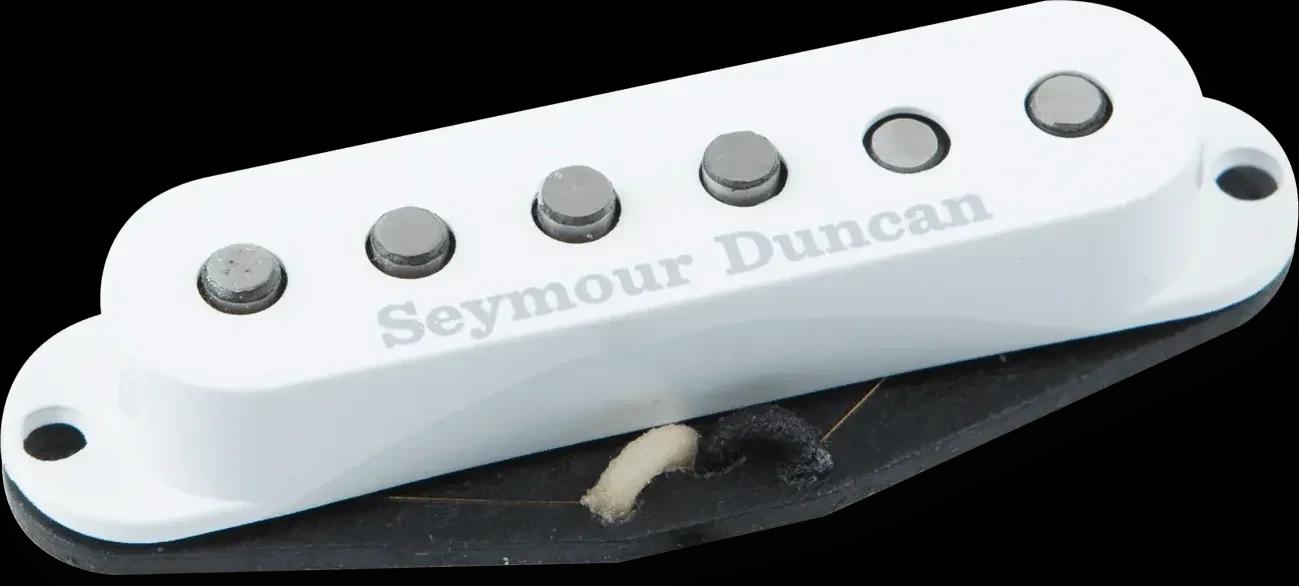
- The magnet. Either the pole pieces are magnets themselves (as in a Fender-style single coil, which uses six rod magnets), or a bar magnet sits underneath and steel pole pieces carry its field up to the strings (as in most humbuckers and the P-90). The magnet's material changes the strength and character of the field: alnico (an alloy of aluminium, nickel and cobalt) in several grades, or ceramic.
- The coil. Thousands of turns of insulated copper wire on a bobbin. Seymour Duncan names 42, 43 and 44 AWG as the most common gauges for guitar pickups; thinner wire lets more turns fit in the same space.
- The pole pieces. These focus the field under each string. They can be fixed slugs, adjustable screws or a single blade.
- The leads. Two conductors on a simple single coil, or four conductors plus a bare shield on most modern humbuckers, which lets the two coils be wired in different ways.
More wire means more output and less treble
Adding turns to the coil raises the voltage the pickup produces, which is why "hot" pickups are wound with more wire than vintage ones. But a bigger coil also has more inductance, and inductance works against high frequencies. Seymour Duncan's own explanation puts it simply: less wire gives a clearer sound with more highs, while more wire pushes the mids forward at the expense of the treble.
Every passive pickup has a resonant peak, a frequency where its response rises before it falls away; Sound on Sound puts it at roughly 2.5 to 4.5 kHz for a typical pickup, and the pots, cable and amp input all move it. A lightly wound pickup peaks high, which sounds bright and open; a heavily wound one peaks lower, which sounds thicker and more midrange-focused. The guide to pickup specifications explains how DC resistance, inductance and resonant peak are measured and why the first of these is the least useful.
One coil or two
A coil cannot tell the difference between the string and any other changing magnetic field nearby. Mains wiring, transformers and lighting all radiate a field at the mains frequency, and a single coil picks it up as hum.
The humbucker answers this with two coils wound in opposite directions and with opposite magnetic polarity. Hum arrives at both coils in the same way and cancels out. The string signal, because the magnetic polarity is also reversed, adds together instead. The trade-off is that two coils sense a wider stretch of string and have more combined inductance, so a humbucker usually sounds thicker and louder than a single coil.
These are the two families most guitars are built around. The explainers cover each in detail: single coil pickups, humbuckers and mini humbuckers, with a direct comparison in single coil vs humbucker. Bass pickups follow the same physics with longer, stronger strings; see bass pickups explained. The P-90 is a wide single coil that sits between them, and types of guitar pickups sets every design side by side.
Where the pickup sits changes the tone
A string vibrates in a complex pattern made of its fundamental and many overtones. Near the bridge the string moves less, and what movement there is carries a high share of upper harmonics, so a bridge pickup sounds brighter and thinner. Closer to the neck the string swings more widely and the fundamental dominates, so a neck pickup sounds rounder and fuller.
That is why makers often wind bridge humbuckers hotter than neck ones. Seymour Duncan's '59, for example, is listed at 7.6k for the neck and 8.2k for the bridge. Distance from the strings matters as well: a pickup set too close pulls on the strings and can cause false notes, while one set too low sounds weak. The tutorial on how to set pickup height covers the adjustment.
Passive and active pickups
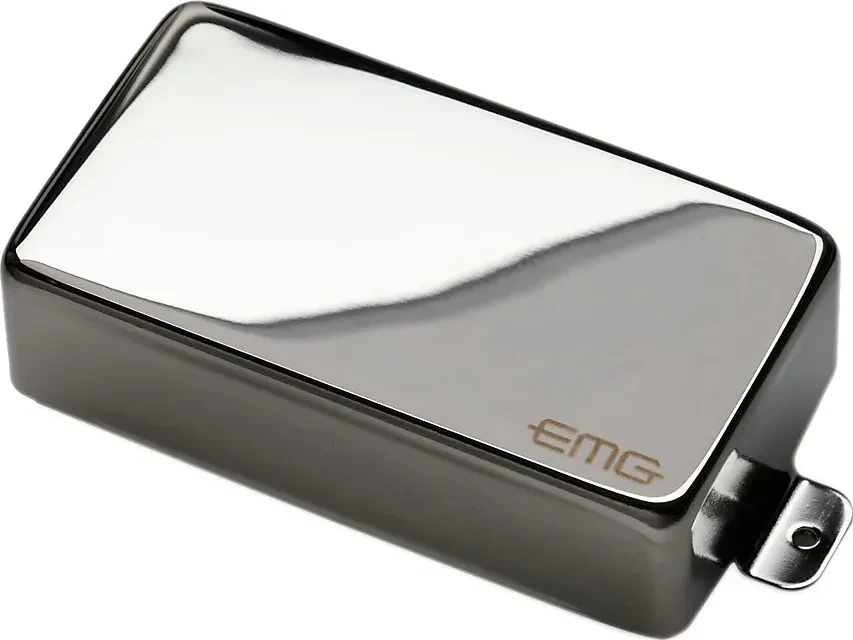
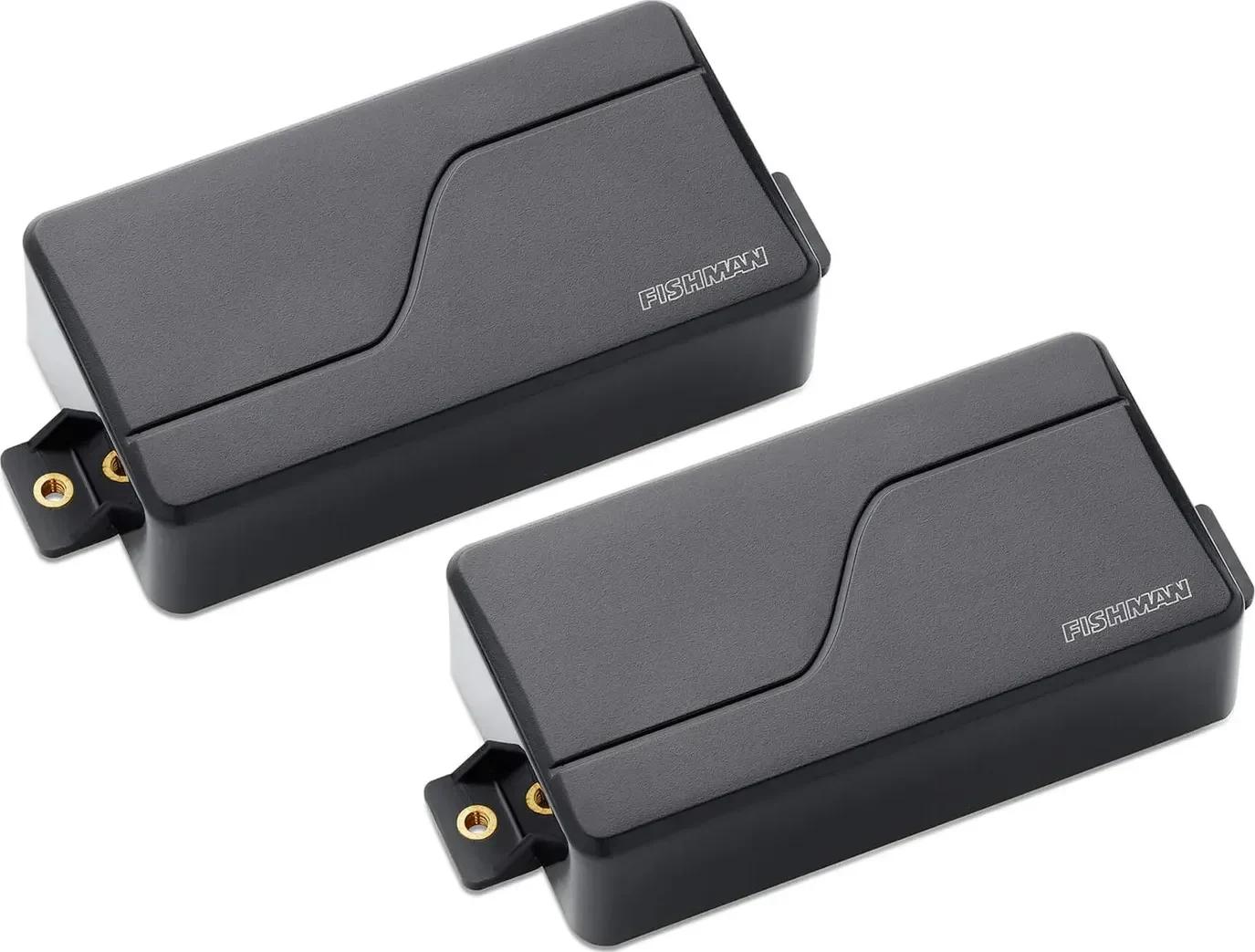
Everything above describes a passive pickup, which needs no power because the string generates the signal. An active pickup uses a smaller, lower-output coil and a battery-powered preamp inside the pickup or guitar to raise and shape the signal. Seymour Duncan notes that the smaller coils make active pickups much less sensitive to outside interference, which is why they are known for being very quiet. The EMG 81 and the Fishman Fluence Modern are the best-known examples. The active vs passive pickups guide compares the two approaches.
The controls finish the job
A passive pickup does not work alone. The volume and tone pots, the tone capacitor and the cable all load the pickup and trim its treble. A higher-value pot loses less treble, which is why humbuckers are usually paired with 500k pots and single coils with 250k. The guide to 250k vs 500k pots explains the effect, and the Parts and Wiring hubs collect the guides to the rest of the circuit.
If you are thinking about changing the pickups in your guitar, start with how to change a pickup, then look at the pickup reviews, from the vintage-voiced Seymour Duncan SSL-1 to the high-output Seymour Duncan JB.