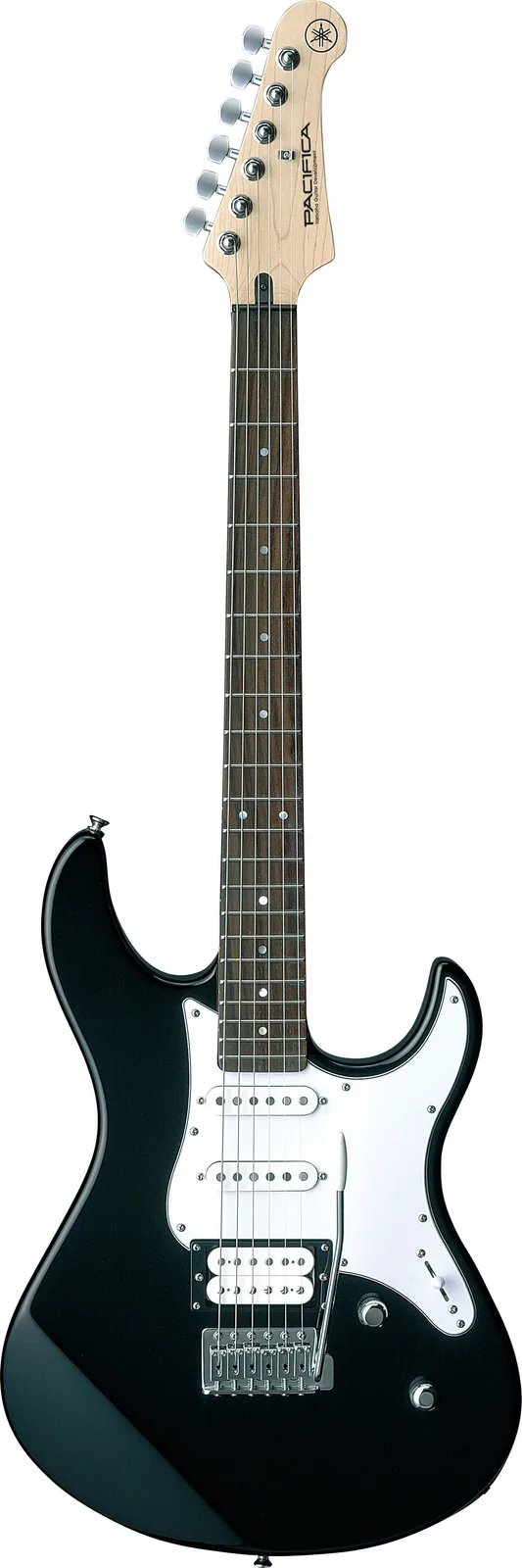
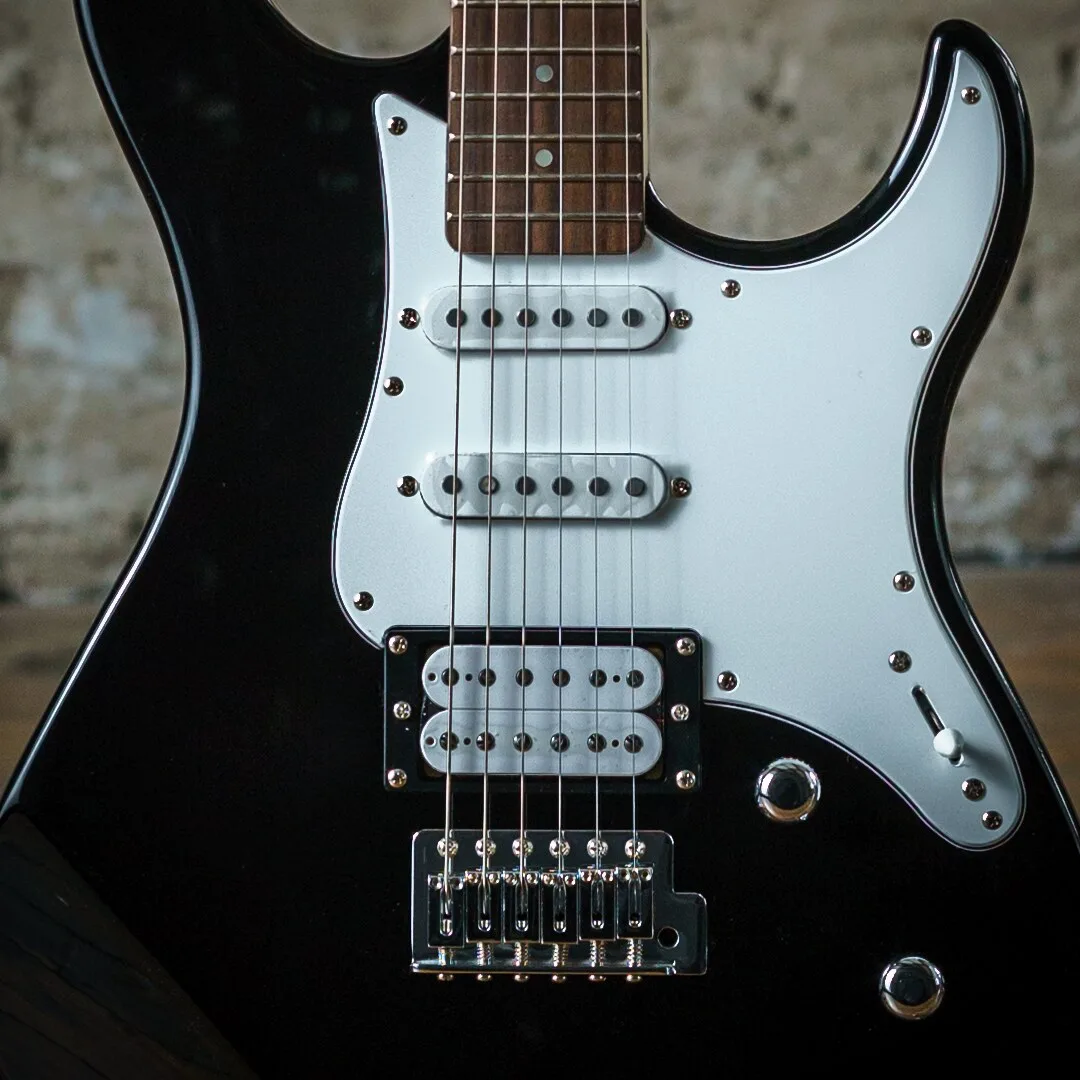
A humbucker is two single coils wired together, in series and with opposite magnetic polarity, so their hum cancels and their signal adds. A coil split switches one of those coils off. The pickup then behaves like a single coil: brighter, lower in output, clearer in the low end, and no longer hum-cancelling.
A push-pull pot is the tidiest way to add the switch. It looks like an ordinary knob, works as an ordinary volume or tone control, and has a small switch on its back that you operate by pulling the knob up. Yamaha's Pacifica 112V uses exactly this arrangement on its tone control.
How the split works
Inside a four-conductor humbucker, each coil has a start and a finish lead. For normal use, the finish of one coil is joined to a lead of the other, so the two coils run in series from the ground lead to the hot lead. That join is the series link.
Seymour Duncan explains the split simply: connect the series link to ground, and the coil between ground and the link is shorted out. The other coil, the one attached to the hot lead, keeps working on its own.
Which coil you keep
With the series link grounded, the coil you keep is the one on the hot lead. Seymour Duncan states that on its humbuckers this is the slug coil (the one with fixed pole pieces). Bare Knuckle's cross-reference chart shows the hot lead on the same coil for DiMarzio, Gibson and Fender. Some models differ, and DiMarzio's own manual notes that its Bluesbucker is arranged differently from its other humbuckers, so check your pickup's sheet.
If you would rather keep the other coil, connect the series link to the hot lead instead of to ground. That shorts the coil on the hot side and leaves the coil on the ground side working.
Parts list
| Part | Value or type | Note |
|---|---|---|
| Four-conductor humbucker | One per split | Two-conductor pickups cannot be split |
| Push-pull pot | 500k, with a DPDT switch | Replaces an existing volume or tone pot |
| Hook-up wire | Short length | From the series link to the switch |
| Heat-shrink sleeving | To insulate the series link joint | |
| Multimeter | To identify the switch lugs |
Wire colours by maker
| Maker | Hot (to volume input or selector) | Series link pair (to the switch) | Ground (with bare) |
|---|---|---|---|
| Seymour Duncan | Black | Red and white | Green |
| DiMarzio | Red | Black and white | Green |
| Gibson | Red | Green and white | Black |
| Fender | Green | Black and white | Red |
Seymour Duncan's code is from its own documentation; the others are from Bare Knuckle's cross-reference chart. Confirm against the sheet that comes with your pickup.
Safety and soldering
Work in a ventilated room, keep the iron in its stand when it is not in your hand, and wash your hands after handling lead-based solder. Push-pull switch lugs are small and close together: heat each quickly and avoid bridging two lugs with solder. Protect the finish around the cavity.
Identify the switch lugs
The switch on a push-pull pot is a DPDT: two rows (poles) of three lugs. In each row the centre lug is the common, and the knob's position connects it to one outer lug or the other. Which outer lug connects in the pulled-up position varies between makes, so check:
- Pull the knob up.
- Set a multimeter to continuity and touch the centre lug of one row and each outer lug in turn.
- The outer lug that beeps is the "up" lug. Mark it.
You need only one row for a coil split.
Connections
Fit the push-pull pot in place of the old pot first, wiring its pot lugs exactly as the old pot was wired. Then:
| # | From | To | Note |
|---|---|---|---|
| 1 | Pickup hot lead | Volume input lug or pickup selector, as before | Unchanged |
| 2 | Pickup ground lead and bare wire | Ground (a pot casing) | Unchanged |
| 3 | Series link pair, soldered together | Hook-up wire | Insulate the joint with heat-shrink |
| 4 | Hook-up wire from the series link | Switch, centre lug of one row | |
| 5 | Switch, the "up" lug of the same row | Ground (pot casing) |
Knob down: the series link is not connected to anything, and the pickup works as a full humbucker. Knob up: the series link is grounded and the pickup is split.
To split two humbuckers, give each its own push-pull pot, or use the second row of the same switch for the second pickup's series link (rows 4 and 5 again, on the other row), which splits both together.
Test before you close it up
Plug in at low volume. Tap the pickup's pole pieces with a steel screwdriver with the knob down: both coils should respond. Pull the knob up and tap again: only one coil should respond, and the sound should be brighter and quieter. If the split mutes the pickup entirely, the hot lead rather than the series link has probably gone to the switch.
What to expect
A split humbucker is noticeably quieter than the full pickup, so expect to adjust your amp when you switch. Many players find a split bridge humbucker useful for clean rhythm parts, and a split neck pickup good for a lighter, glassier tone. If you want a brighter sound that keeps the hum cancelling, look at series and parallel switching instead: parallel mode keeps both coils working.
For how the two coils of a humbucker cancel hum in the first place, read humbuckers explained. For the rest of the Les Paul circuit, see Les Paul wiring: ’50s vs modern, and the Wiring hub for more circuits.