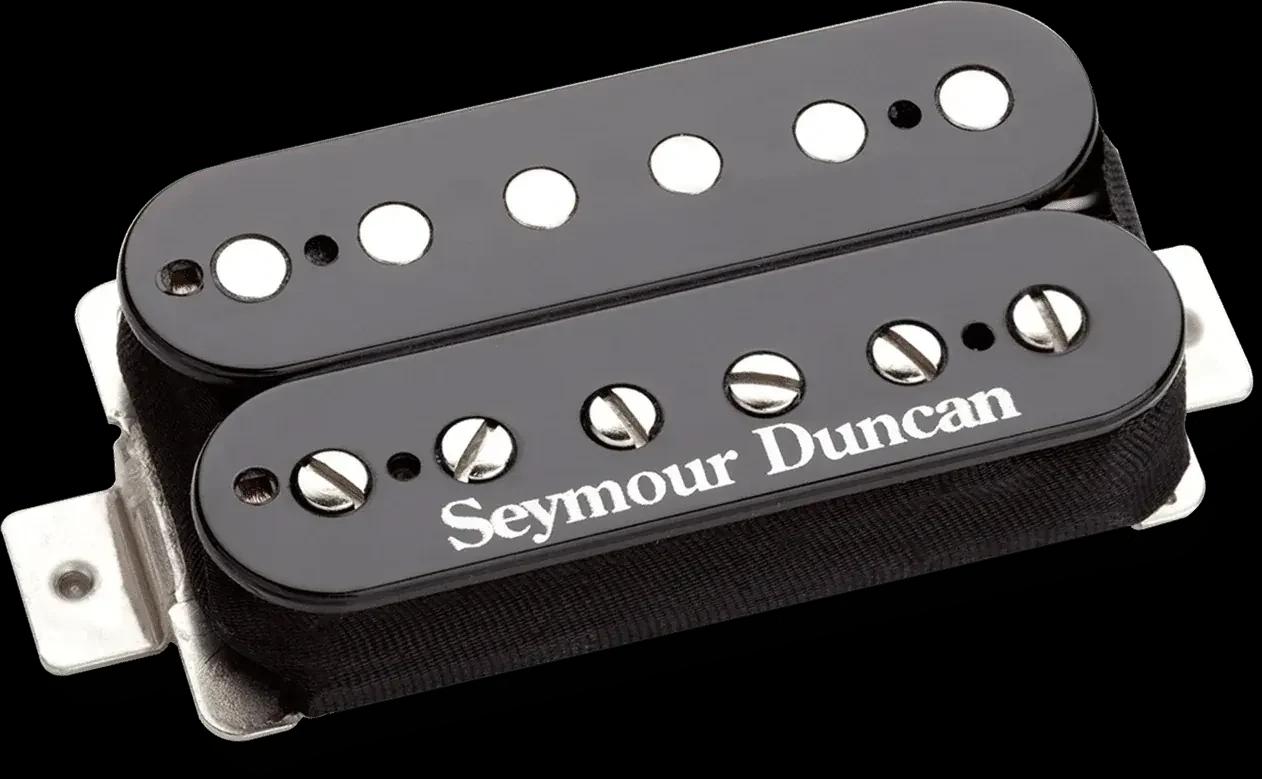
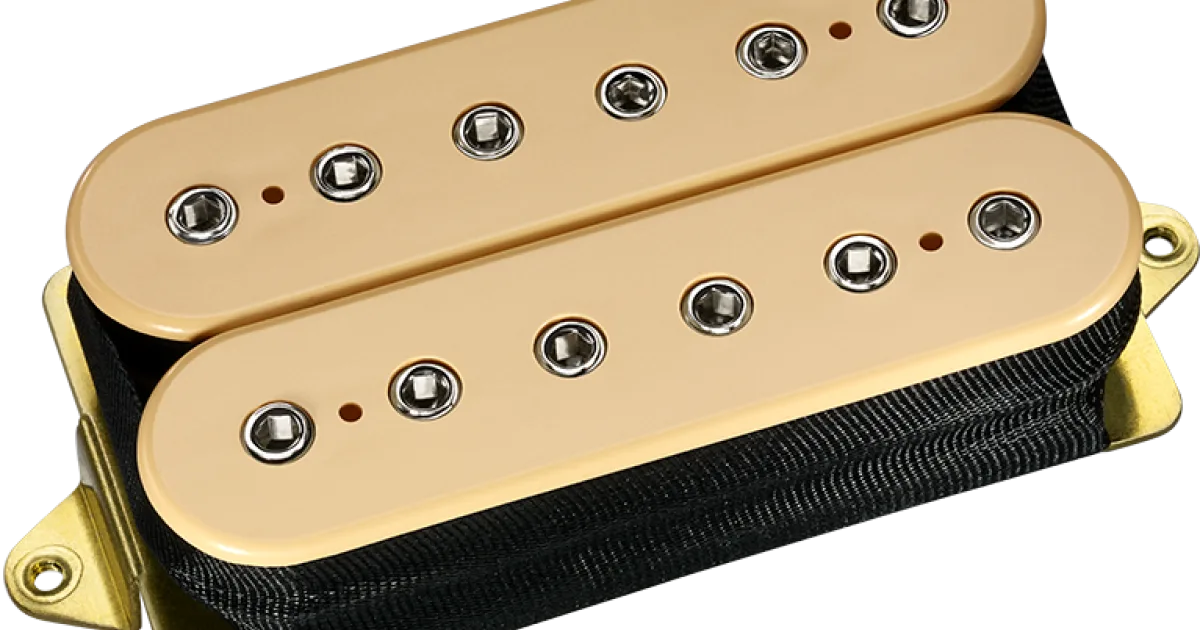
A humbucker's two coils are normally connected in series: one after the other, so the signal passes through both. They can also be connected in parallel: side by side, both feeding the output at once. A push-pull pot lets you choose either at any time.
Series is the familiar humbucker sound: full, thick, strong in the midrange and high in output. Parallel is brighter and clearer with less output, closer to a single coil, but because both coils are still working with opposite polarity, it keeps cancelling hum. That is its advantage over a coil split, though Premier Guitar's Mod Garage column notes that parallel sounds closer to a P-90 than to a true Strat or Tele single coil.
Why parallel sounds the way it does
Two equal coils in series add their resistance and inductance together. In parallel, they halve it. So the same pickup in parallel has roughly a quarter of the DC resistance it has in series, and much lower inductance. Lower inductance moves the pickup's resonant peak higher, which is heard as a brighter, more open sound, as StewMac and Lollar both describe it; the drop in output is why parallel is also noticeably quieter. Premier Guitar puts the loss at about a fifth of the volume.
You can see this with a multimeter: measure the pickup across hot and ground in each mode once it is wired.
The two connections, by maker
Every four-conductor humbucker has one lead that is always hot, one that is always ground (with the bare shield wire), and a pair that forms the series link. Switching between series and parallel moves only that pair.
| Maker | Always hot | Always ground (with bare) | Series: join together | Parallel: to hot | Parallel: to ground |
|---|---|---|---|---|---|
| Seymour Duncan | Black | Green | Red and white | Red | White |
| DiMarzio | Red | Green | Black and white | White | Black |
| Gibson | Red | Black | Green and white | Green | White |
| Fender | Green | Red | Black and white | Black | White |
The Seymour Duncan row matches Seymour Duncan's own description of its standard hookup and the parallel connection in Premier Guitar's Mod Garage column, which uses Seymour Duncan's colours. The DiMarzio, Gibson and Fender rows follow from Bare Knuckle's cross-reference chart, which gives the start and finish of each coil for every maker, using the same rule: in parallel, the start of one coil joins the finish of the other at the hot, and the remaining two leads go to ground. Confirm against your pickup's own sheet before soldering.
Parts list
| Part | Value or type | Note |
|---|---|---|
| Four-conductor humbucker | One per switch | |
| Push-pull pot | 500k, with a DPDT switch | Replaces an existing volume or tone pot |
| Hook-up wire | Short lengths, two colours | |
| Heat-shrink sleeving | For the series-link leads | |
| Multimeter | To find the switch lugs and test the result |
Safety and soldering
Work in a ventilated room, keep the iron in its stand when not in use, and wash your hands after handling lead-based solder. The lugs on a push-pull switch are small and close: heat each one briefly and keep solder from bridging neighbouring lugs.
Identify the switch lugs
A push-pull DPDT has two rows of three lugs. The centre lug of each row is its common. Pull the knob up and use a multimeter on continuity to find which outer lug in each row connects to the centre in the up position. Mark those as the "up" lugs; the other outer lug in each row is the "down" lug.
Connections
Fit the push-pull pot first, wiring its pot lugs as the old pot was wired. In the table, "link A" is the lead that goes to hot in parallel and "link B" is the lead that goes to ground in parallel (see the maker table).
| # | From | To | Note |
|---|---|---|---|
| 1 | Always-hot lead | Volume input lug or pickup selector, as before | Unchanged |
| 2 | Always-ground lead and bare wire | Ground (pot casing) | Unchanged |
| 3 | Link A | Row 1, centre lug | Separate the series-link pair first |
| 4 | Link B | Row 2, centre lug | |
| 5 | Row 1, down lug | Row 2, centre lug | Joins link A to link B in the down position (series) |
| 6 | Row 1, up lug | The same point as the always-hot lead | In the up position, link A joins the hot |
| 7 | Row 2, up lug | Ground (pot casing) | In the up position, link B goes to ground |
Row 2's down lug is left empty.
Knob down: link A meets link B through the jumper, and the pickup is in series. Knob up: link A goes to hot and link B goes to ground, and the pickup is in parallel.
Connection 6 must meet the hot lead before any pickup selector switch, at the same lug the hot lead is soldered to, so the parallel coil follows the selector like the rest of the pickup.
Test before you close it up
Plug in at low volume and tap the pole pieces with a steel screwdriver in each knob position. Both coils should respond in both positions. Pulled up, the pickup should sound brighter and quieter but stay quiet with the guitar near a source of hum. If the pickup goes silent in parallel, link A and link B are the wrong way round, which shorts both coils: swap connections 3 and 4 and test again.
Before refitting everything, measure across the pickup's hot and ground with a multimeter in each position. The parallel reading should be about a quarter of the series reading.
Where it suits
Parallel suits clean and lightly driven sounds from a hot bridge humbucker such as the Seymour Duncan JB or DiMarzio Super Distortion, both of which come with four-conductor leads. Premier Guitar's Guitar Shop 101 column used parallel wiring to brighten a dark-sounding Strat with two humbuckers, a JB and a Jazz, keeping the original three-way switch.
For the theory behind the two coils, read humbuckers explained. For a Les Paul's full circuit, see Les Paul wiring: ’50s vs modern, and the Wiring hub for every wiring guide on the site.