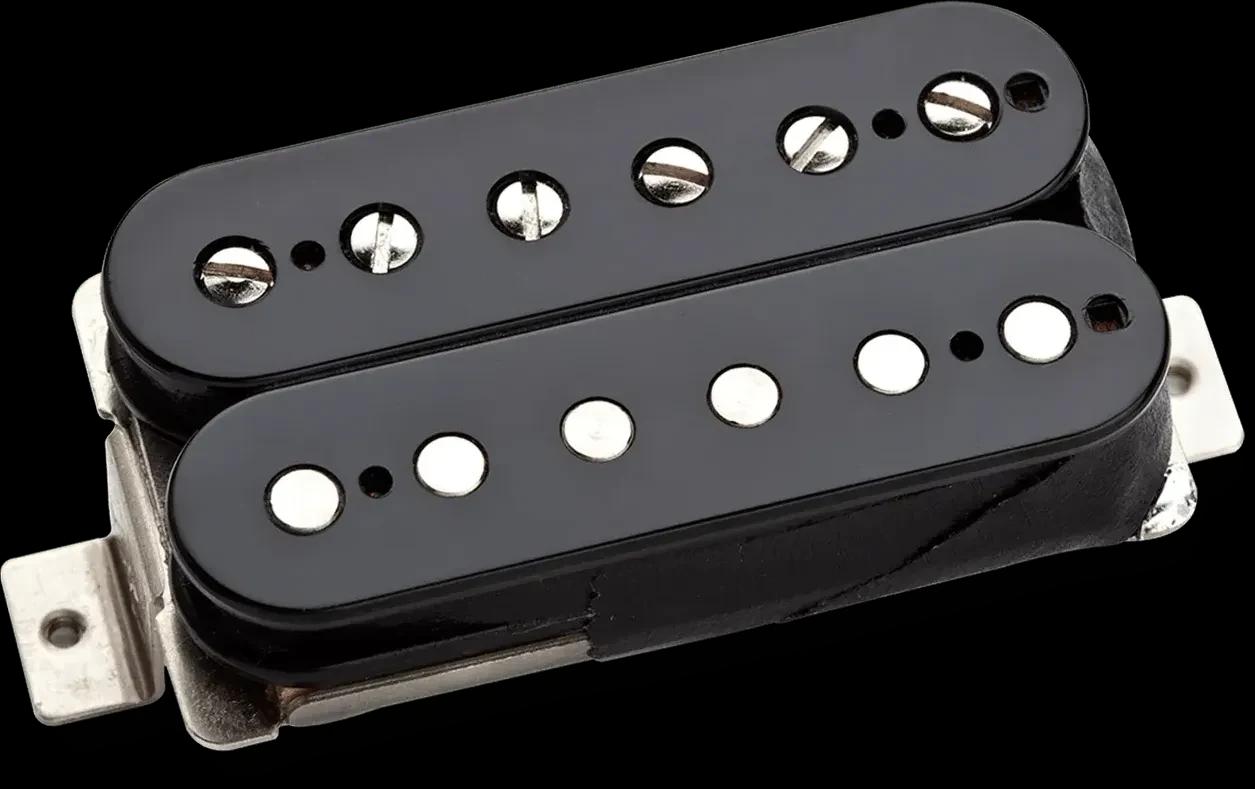
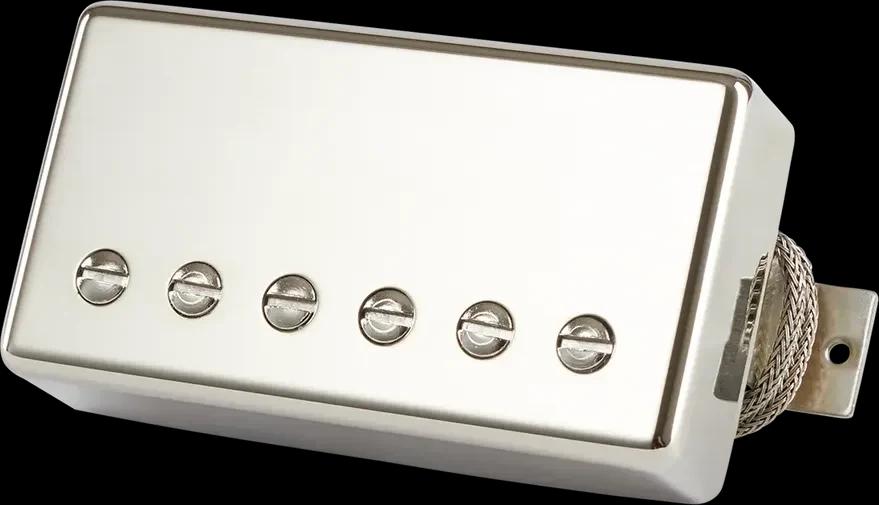
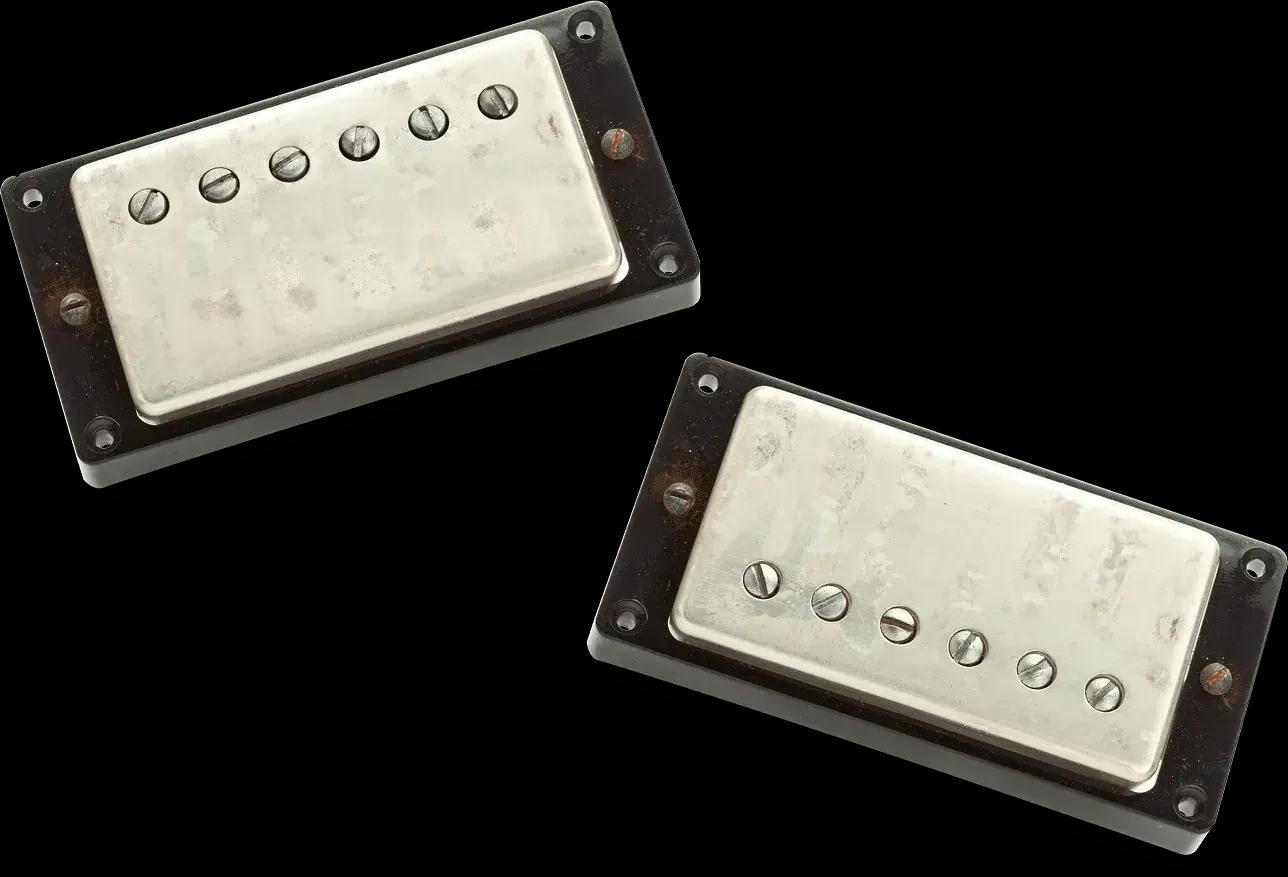
A humbucker is a guitar pickup made of two coils working as a pair. It was designed to solve one problem, the mains hum that single coils pick up, and in solving it created a sound of its own: thicker, louder and warmer than a single coil, and the sound of a great deal of rock and metal guitar since the late 1950s.
Two opposite coils cancel the noise
A pickup coil cannot tell the vibration of a string from any other changing magnetic field around it. Mains wiring, transformers and lighting all produce one, so a single coil hums.
A humbucker places two coils side by side and makes them opposites in two ways. The coils are wound in opposite directions, and the magnet is arranged so that one coil's pole pieces present a north pole to the strings and the other's a south pole. Hum from outside reaches both coils in the same way, and because of the reversed winding the two hum signals cancel. The string signal is different: it is shaped by the magnets, so the reversed polarity flips it back, and the two string signals add together. Noise goes down, signal goes up.
The cancellation is not perfect. DiMarzio's FAQ points out that a humbucker deals with 50 to 60 Hz mains hum but not with higher-frequency hash from lighting and dimmers.
The PAF humbucker started it
Hum-cancelling coils were not new: Premier Guitar traces patents for hum-cancelling guitar pickups back to at least 1936. The design players know came from Seth Lover at Gibson, who presented it in early 1955 and filed the patent that June. That patent, US 2,896,491, was issued in July 1959; until then the pickups carried a sticker reading "Patent Applied For", and the nickname PAF stuck. Ray Butts was developing a humbucker of his own at the same time, which Gretsch built as the Filter'Tron, and his patent, filed in 1957, was granted four weeks before Lover's.
What made a PAF is well documented. Seymour Duncan's history of the pickup describes coils of 42-gauge plain enamel wire aimed at 5,000 turns a bobbin on machines that workers stopped by hand, alnico 2, 3, 4 or 5 magnets used more or less at random until late 1961, and no wax potting, so the originals are microphonic. Output ran from about 7.5k to 9k, and two PAFs made in the same year could sound noticeably different. The sound it describes is full and uncompressed, a little less bright than a single coil, with lows, mids and highs in balance.
Most "vintage" humbuckers made today, such as the Seymour Duncan '59, are modelled on the PAF: alnico magnet, moderate winding, airy and fairly bright for a humbucker. Gibson's ’57 Classic and Seymour Duncan's aged Antiquity are two more of the PAF-style designs that Seymour Duncan's history names. In the early 1970s DiMarzio brought out the Super Distortion, which the company describes as the first replacement pickup, made to be fitted to a guitar that had left the factory. The idea of a hotter humbucker for driving an amp harder took off from there.
A humbucker has the same few parts in almost every model
Seymour Duncan's breakdown of a humbucker and its product pages describe these core parts:
- Two bobbins, one with adjustable screw pole pieces and one with fixed slugs on a traditional design, each holding thousands of turns of fine copper wire.
- A bar magnet under the bobbins, between them, feeding both rows of pole pieces. Alnico in grades II to VIII and ceramic are all used.
- A baseplate, usually nickel silver, that holds everything together and gives the mounting points.
- A spacer that sits between the baseplate and the coils, with the magnet alongside it.
- A cover, often nickel, though many modern humbuckers are sold open as well.
- Wax potting, which stops the coils and cover vibrating and causing squeal at high gain. Original PAFs were not potted and were microphonic; most modern ones are.
Some designs replace the six pole pieces in a coil with a single bar or rail, which avoids the drop in volume when a string is bent away from a pole piece.
Output varies hugely between models
"Humbucker" describes the layout, not the output. Seymour Duncan lists its '59 bridge model at 8.2k DC resistance and the JB at 16.6k; DiMarzio lists the Super Distortion at 13.68k with a ceramic magnet. Those three sound very different, from clear and dynamic to thick and compressed. DC resistance is only a rough guide, as the pickup specifications guide explains, and the magnet, wire and pole pieces all count.
Bridge humbuckers are usually wound hotter than neck models to balance the quieter, brighter string movement near the bridge. Most are sold in both versions, and some in a wider "trembucker" or F-spaced version so the pole pieces line up with the strings on guitars with wide-spaced vibrato bridges.
Active humbuckers such as the EMG 81 and Fishman Fluence Modern work differently again, with a low-output coil and a battery-powered preamp; see active vs passive pickups.
High-output humbuckers drive the amp harder
The extra level comes from more wire, a stronger magnet or both. Seymour Duncan's explanation of inductance is that a bigger coil gives more output and pushes the mids forward, at some cost to the treble, which is why hot humbuckers sound thick and midrange-heavy rather than simply louder. Ceramic magnets are common in the hottest passive models, and Seymour Duncan describes ceramic as bright and edgy, with aggressive upper mids and a punchy low end.
The JB and the Super Distortion are the classic examples. Seymour Duncan lists its Invader bridge model at 16.6k, the same figure as the JB, but with three ceramic bar magnets, and calls it the thickest, deepest-sounding passive pickup it makes. DiMarzio gives its alnico 5 Tone Zone as 17.31k.
A hot pickup does not distort on its own. DiMarzio's FAQ is clear that every magnetic pickup produces a clean signal: a "distortion" pickup is a high-output one that pushes the amp or pedal into breakup sooner, and an amp set clean may stay clean. At very high gain, DiMarzio adds, single notes lose definition and chords can blur, and turning the amp's first gain stage down is the cure.
Four-conductor wiring opens up options
Older humbuckers had one conductor and a braided shield: the two coils were joined inside the pickup and could only be used as a pair. Most modern humbuckers bring out both ends of both coils as four coloured wires plus a bare shield, so the coils can be connected in different ways.
The colours vary by maker. Seymour Duncan uses black for hot, green and bare to ground, and red and white joined together as the link between the coils. DiMarzio uses red for hot, green and bare to ground, and black and white joined. Check the maker's chart before soldering, especially when mixing brands.
With four conductors you can wire the pickup three main ways:
- Series, the standard humbucker sound, with both coils in a chain for full output and hum cancelling.
- Split, which grounds the link between the coils so only one coil works. It sounds brighter and thinner, closer to a single coil, but hums like one. The push-pull coil split wiring tutorial shows how.
- Parallel, with both coils working side by side. It keeps the hum cancelling but drops output and brightens the tone. See series and parallel switching.
Most humbuckers fit the same standard route
Les Pauls, SGs, PRS models and superstrats all share it, with the pickup held in a mounting ring or screwed directly to the pickguard. Changing one is a straightforward soldering job, covered in how to change a pickup, and setting the height afterwards makes a large difference to balance; see how to set pickup height. For Les Paul wiring specifically, see Les Paul wiring: '50s vs modern.
Humbuckers are normally used with 500k volume and tone pots, which keep the treble that a humbucker's larger coils already reduce. The 250k vs 500k pots guide explains why. For what a metal cover does and how to fit one, see guitar pickup covers.
If you want something in between, the mini humbucker is a narrower, brighter take on the same idea. For a broader look at the choice, read single coil vs humbucker, and for picks, the best humbuckers for a Les Paul guide. The classic high-output pairing is compared head to head in Seymour Duncan JB vs DiMarzio Super Distortion.