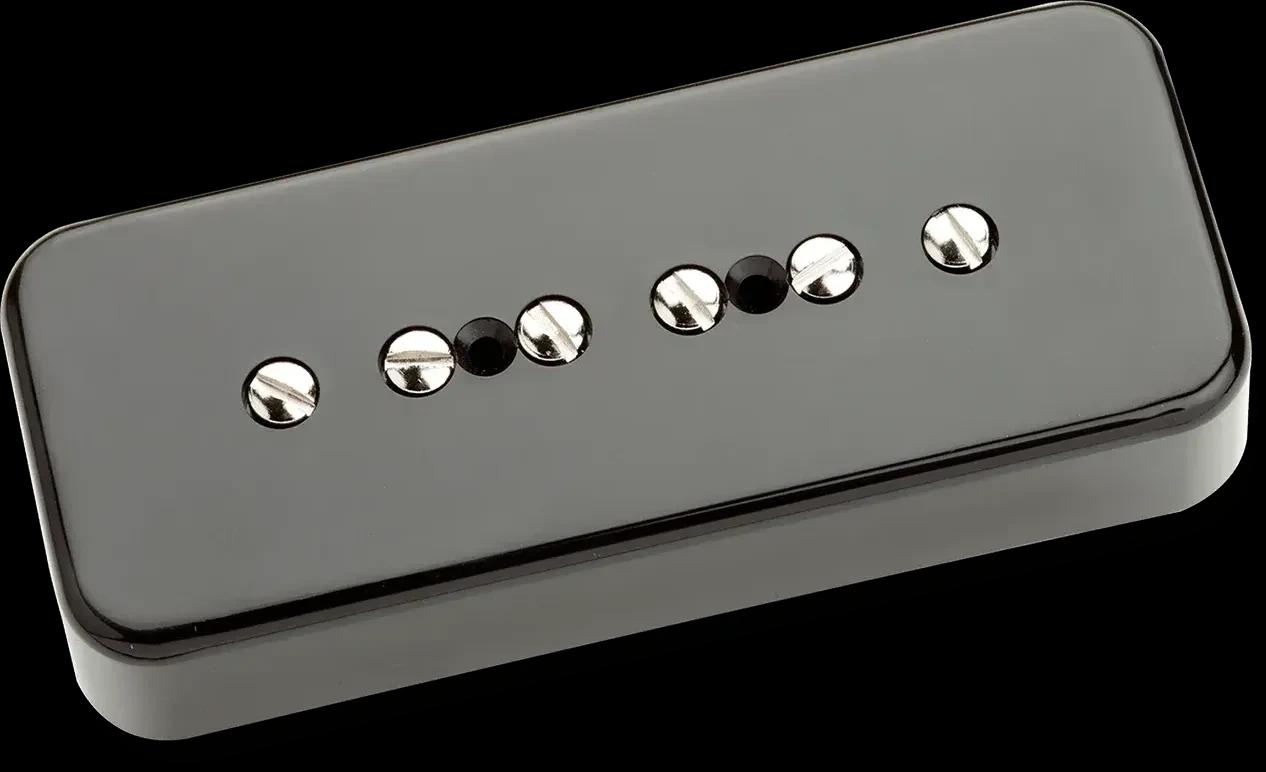
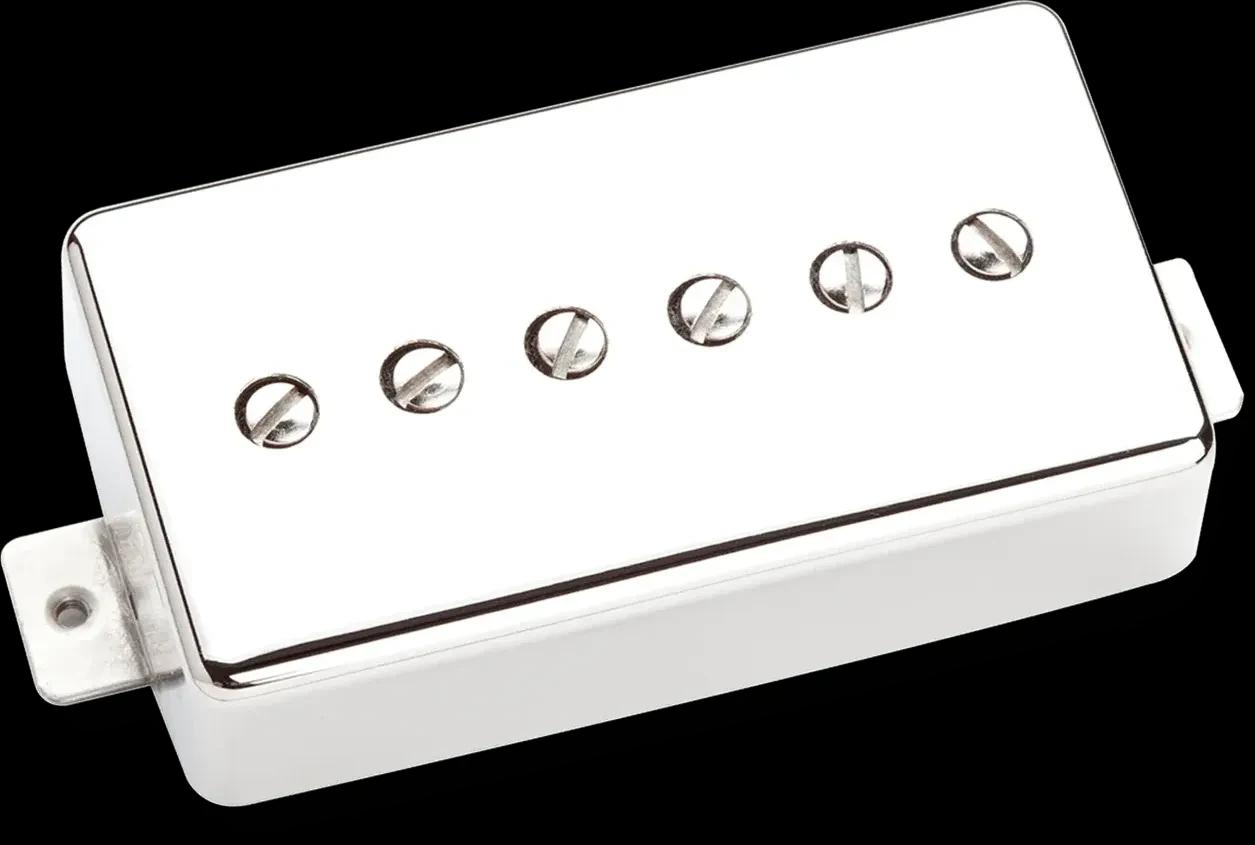
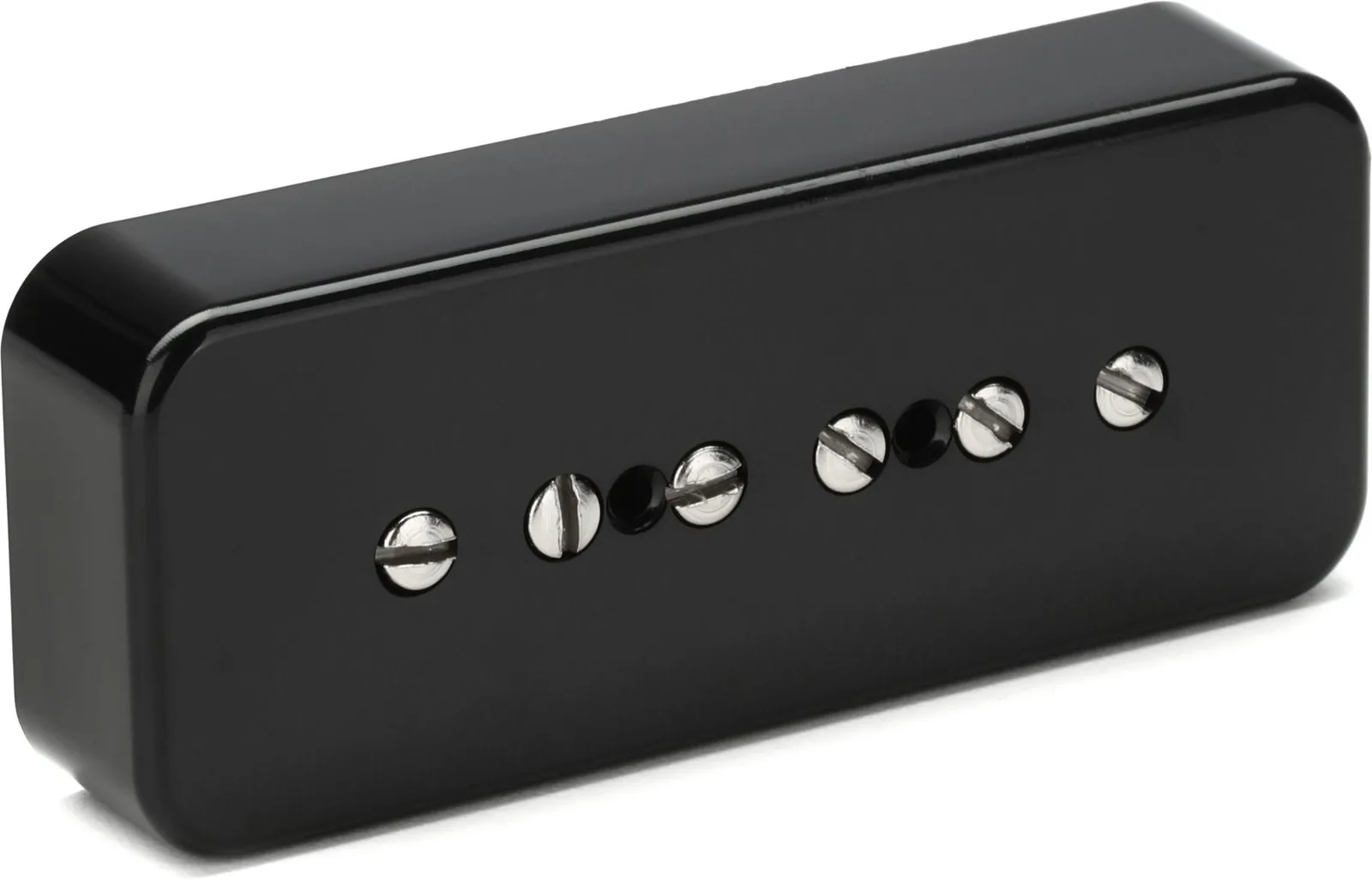
A P-90 (often written P90) is Gibson's single-coil pickup, first made in 1946. It has one coil like a Strat pickup, so it hums like one, but the coil is short and wide and sits over two bar magnets. That build puts its sound between a Fender single coil and a humbucker: more low end, midrange and output than the first, more bite and grit than the second. It comes in two shapes, soapbar and dog-ear, and in versions made to fit a humbucker's route.
A P-90 is a single coil built short and wide
Guitar World credits Walt Fuller, head of Gibson's electronics department, with the design in 1946. It was Gibson's premium pickup until the company's top models moved to humbuckers from 1957.
The construction is what makes it different. Guitar World describes a coil of 42-gauge plain enamel wire, shorter and wider than most Fender coils, wound round six adjustable steel pole screws. Under the bobbin sit two alnico bar magnets with a steel spacer between them, both turned so that their south poles face the pole screws in the middle. A Fender-style single coil has no bar magnet at all: its six rod magnets are the pole pieces, and the wire is wound straight round them.
MusicRadar's history puts the usual winding at around 10,000 turns, often fewer, and the DC resistance of vintage examples most often between 7.2k and 8.1k. Modern recreations sit close to that. Seymour Duncan lists its Vintage P90 (SP90-1) at 8k for the neck and 9.7k for the bridge, with two alnico 5 magnets and plain enamel wire wound on the Leesona machine Gibson used in the 1950s; DiMarzio gives its Vintage P90 as 8.12k with two alnico 5 magnets.

It sounds between a Strat pickup and a humbucker
Against a Fender-style single coil, Guitar World's history says a P-90 has more bass, more low mids and more sustain, where the Fender coil decays more sharply. The two full-size magnets give it high inductance by single-coil standards, which means more output, and Seymour Duncan describes its own version as having a powerful midrange and higher output than most other types of single coil. Andertons sums the result up as bright, clear and raspy, grittier than a classic single coil, with rounder highs.
Against a humbucker, the P-90 is the rawer of the two. Seymour Duncan calls humbuckers generally less gritty and crunchy than a P-90, and finds its vintage-style P-90 a little cleaner than a humbucker when the volume is rolled down. Jon Gundry of ThroBak, interviewed by MusicRadar, hears a P-90 compress more under the pick than a PAF-style humbucker, with a little less dynamic range, and sound slightly squishier when distorted. The full comparison is in P-90 vs humbucker.
The sound has a long list of homes. Guitar World traces the P-90's return in the 1960s through Pete Townshend and Carlos Santana, and notes that Mick Jones of the Clash and Steve Jones of the Sex Pistols played P-90 Les Paul Juniors in the 1970s; Andertons adds rock, jazz, country and blues. Within the type, output changes the character. Gundry describes lower-wound P-90s as crisper and cleaner, with more headroom from the amp, and hotter ones as fatter and more aggressive, with more midrange.
It hums like any single coil
One coil means no hum cancelling. Andertons is plain that P-90s hum like a single coil, Seymour Duncan says a true single coil always carries some background noise, and Guitar World notes that a P-90 can act like an antenna for radio interference where a humbucker does not.
There are three ways round it:
- A matched pair. Seymour Duncan winds the neck Phat Cat in reverse with reversed polarity, so the pair cancels hum with both pickups on. Each still hums on its own.
- A stacked P-90. Seymour Duncan's P90 Stack is a noiseless soapbar with dual alnico 5 magnets and a four-conductor lead. At 0.95 inch tall it is taller than a typical P-90, so the maker advises checking the depth of the route.
- A dual-coil P-90. DiMarzio's Virtual P90 is a soapbar with two coils tuned to different ranges, which DiMarzio designed to give the soapbar sound without 60-cycle hum.
Soapbar and dog-ear differ in how they mount
The two names describe the cover and how it is fixed, not what is inside: DiMarzio sells the same Vintage P90 as a soapbar, as a dog-ear and in a humbucker cover.
- Soapbar. A plain rectangle with no ears. Guitar World describes two screws between the A and D and the G and B pole pieces going straight into the body, with the height set by shims, foam or springs. Gibson fitted soapbars to the Les Paul Goldtop, Custom and Special.
- Dog-ear. The baseplate has an ear at each end with a screw hole, and Guitar World says the height is set with shims. Gibson used it on the Les Paul and SG Juniors and on hollow bodies such as the ES-125, ES-225 and ES-330.
StewMac's Gibson-pattern covers show the difference in size. The soapbar cover is 85.7 by 34.9 mm with its mounting screws 19.8 mm apart; the dog-ear is 117.5 by 41.3 mm with its screws 96.8 mm apart. Both have a 49.2 mm pole spread, against 50 mm on StewMac's import-pattern covers, so check which you have before ordering a cover or a replacement.
Humbucker-sized P-90s fit a humbucker route
A traditional P-90 will not go into a humbucker cavity without routing, as Guitar World points out, so makers build P-90s in a humbucker's footprint. The Seymour Duncan Phat Cat is the best-known: Seymour Duncan describes it as a true single-coil soapbar P-90 under a humbucker cover, with two alnico 2 magnets, 7.98k at the neck and 8.49k at the bridge, made to fit any humbucker guitar without modification. DiMarzio mounts its Vintage P90 in a full-size humbucker cover, and Lollar makes its P-90 sounds in soapbar, dog-ear, humbucker and Jazzmaster sizes.
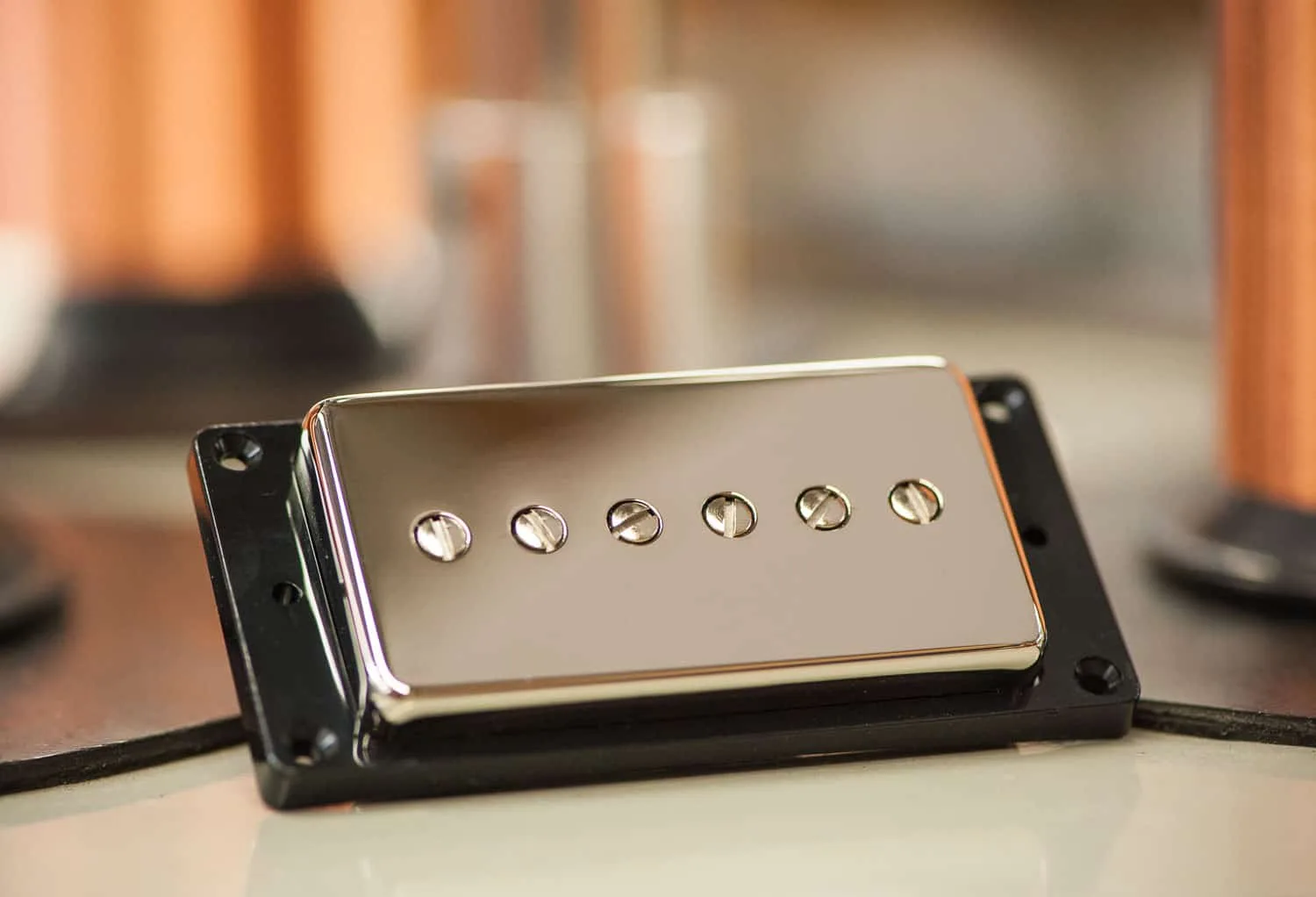
They are close to the real thing, not identical. Premier Guitar's roundup of eight humbucker-sized P-90s points out that moving from the P-90's wide, low coil to a humbucker's taller, narrower bobbin inevitably changes the tone, and that makers often use thinner 43-gauge wire to fit a traditional number of turns. The same roundup covered two hum-cancelling designs with two coils, which trade some P-90 character for silence.
The reverse also exists: hum-cancelling pickups in a P-90's shape, such as the P90 Stack and the Virtual P90 above. Seymour Duncan notes that the humbucker itself started out that way, showing Seth Lover's prototype built in a P-90 format.
Choosing a P-90 comes down to the route
- Soapbar or dog-ear route: a full-size P-90 in the same shape, such as the SP90-1 or Gibson's own P-90, which comes in both shapes. Lower-wound models suit cleaner playing, hotter ones crunch and rock.
- Humbucker route, no woodwork: a humbucker-sized P-90 such as the Phat Cat.
- Need silence: a stacked or dual-coil P-90, accepting a step away from the vintage sound.
Vintage-style P-90s usually have a single-conductor braided lead, so they wire in the traditional way and cannot be split or switched. Gundry's advice is to set a P-90 close to the strings and fine-tune with the pole screws; MusicRadar notes that a P-90 has less magnetic pull than a Fender-style pickup, so it can sit closer without upsetting the strings. The best P-90 pickups guide compares the models reviewed here. The guides to how to change a pickup and how to set pickup height cover the job, types of guitar pickups puts the P-90 beside the other designs, and single coil pickups explained covers the Fender side of the family.