Almost every electric guitar pickup is a magnet and a coil of fine copper wire. What separates the types is how many coils there are, what shape they take and whether a battery-powered preamp follows them. Those choices decide how bright or thick the pickup sounds, how loud it is and whether it hums. Each type below links to the site's deeper guide.
- Single coil: one coil; bright and clear, but it hums.
- Humbucker: two coils wired against each other; thicker, louder and quiet.
- P-90: one short, wide coil; between the two, and it hums.
- Mini humbucker: two narrower coils; brighter than a full-size humbucker.
- Rails, stacked and single-coil-sized humbuckers: two coils in a single coil's space.
- Active or passive: any of the above, with or without a preamp.
- Bass and acoustic pickups: their own designs for their own jobs.
Every magnetic pickup works the same way
The magnet magnetises the steel string above it; when the string vibrates, the field through the coil changes and a small voltage appears across the coil. The detail is in how guitar pickups work, and what the numbers on a spec sheet mean is in pickup specifications explained.
Single coils are bright and clear, but they hum
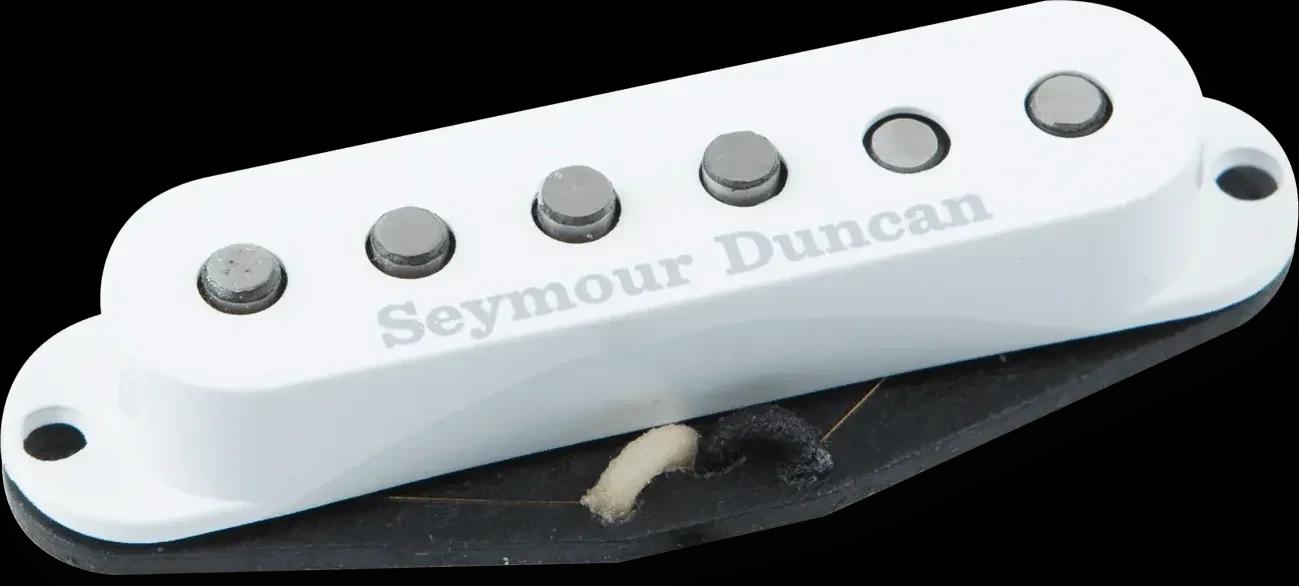
A single coil is one coil and one set of magnets. In Fender's design the six pole pieces are themselves rod magnets, and Seymour Duncan notes that Strat covers have six holes so those rods can come through. A single coil senses a narrow slice of each string, which is why it keeps its treble and attack; Andertons sums the type up as bright, articulate and a little twangy. Seymour Duncan lists its vintage-style SSL-1 Strat pickup at 6.5k.
The catch is noise. One coil picks up mains hum along with the string. Stratocasters and Telecasters are the classic single-coil guitars; see single coil pickups explained, and the Tele bridge pickups reviewed here, such as the Seymour Duncan Vintage Broadcaster and the Fender Pure Vintage ’52 set.
Humbuckers are two coils, thicker and quiet
A humbucker puts two coils side by side, wound in opposite directions with opposite magnetic polarity. Hum arrives at both coils alike and cancels, while the string signal adds. Two coils hear a wider stretch of string and have more combined inductance, so a humbucker sounds thicker and warmer and usually louder; Andertons calls humbuckers bassier and more aggressive than single coils, and best at handling high distortion.
"Humbucker" describes the layout, not the output. Seymour Duncan lists its PAF-style ’59 bridge model at 8.2k and its hot JB at 16.6k. Les Pauls and most rock and metal guitars use them. Read humbuckers explained and single coil vs humbucker.
P-90s are one wide coil, in between
Gibson's P-90 dates from 1946. Guitar World describes a coil shorter and wider than a Fender coil, wound round adjustable pole screws over two bar magnets, which gives it more bass, low mids and sustain than a Fender-style single coil. Andertons places its sound between a single coil and a humbucker. It has one coil, so it hums. Gibson still makes its own P-90; Seymour Duncan lists its Vintage P90 (SP90-1) at 8k and 9.7k, and its Phat Cat is a P-90 under a humbucker cover. See P-90 pickups explained and P-90 vs humbucker.
Mini humbuckers are narrower and brighter
A mini humbucker is a humbucker in a smaller housing, with coils that are smaller and closer together. Guitar World traces the type to Epiphone and the Les Paul Deluxe, and puts the original Epiphone mini at about 4,250 turns a coil against a PAF's nominal 5,000. The narrower window and lower inductance give less bass and more clarity and treble, so a mini sits between a full humbucker and a single coil while still cancelling hum. See mini humbuckers explained.
Rails, stacked and single-coil-sized humbuckers fit a single coil's space
These put two coils where one would normally go, so a Strat or Tele can lose its hum without routing.
- Side-by-side rails. Seymour Duncan's Hot Rails has two steel blades in place of pole pieces and a ceramic magnet in a Strat single coil's footprint, and the bridge model is listed at 16.6k, the same as the full-size JB. Its Little '59 for Tele, at 17.7k, drops into a Tele bridge route. Seymour Duncan notes that a blade or rail avoids the drop in volume when a string is bent away from a pole piece.
- Stacked designs. Two coils one above the other in a single coil's housing, the lower one cancelling hum. Fender's Noiseless pickups are the best-known, and Fender's own pickup designer has said a stacked design tends to cost some top end and feel; see the Fender Noiseless Strat pickups. Seymour Duncan's P90 Stack applies the idea to a P-90.
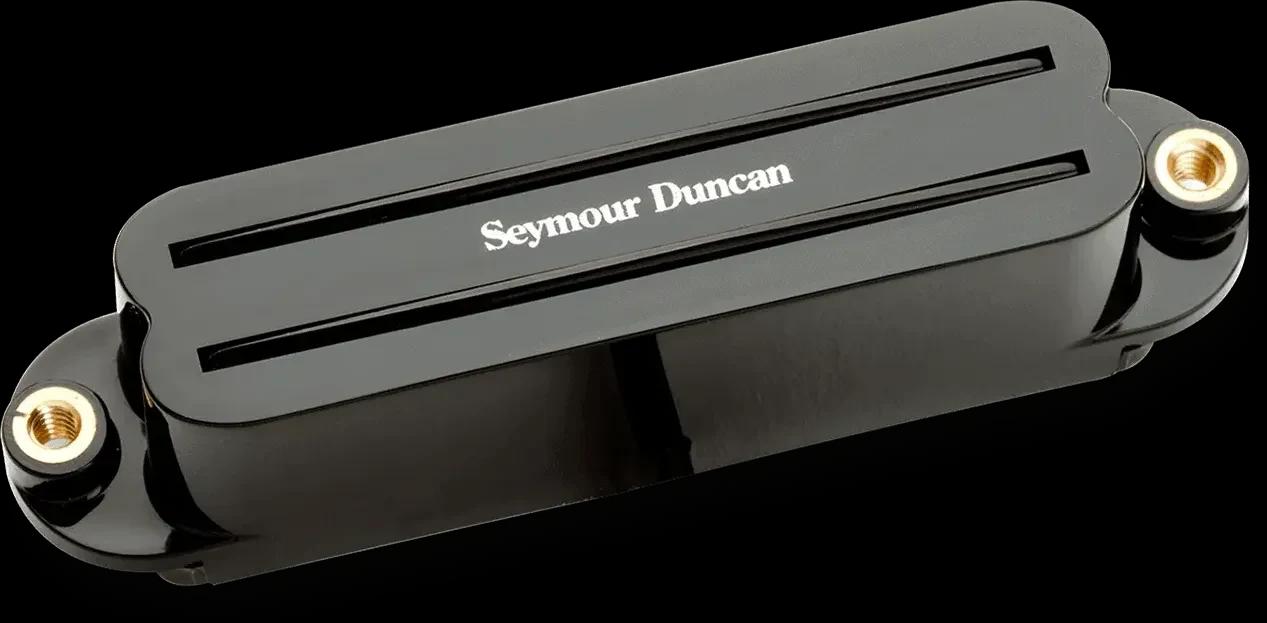
Side-by-side designs such as the Hot Rails usually sound hotter and thicker than the single coil they replace, which owners of the Hot Rails count as the point and some as the drawback: its clean sound is the usual complaint.
Active and passive is a separate choice
Every type above can be passive or active. A passive pickup sends its signal straight to the volume and tone controls and on down the cable. An active pickup has a smaller coil and a built-in preamp run from a battery; Seymour Duncan explains that the smaller coil makes it far less susceptible to interference, and that the preamp sets its output and EQ. Premier Guitar notes that because the preamp buffers the signal, a long cable sounds the same as a short one. Active pickups also take lower-value pots: Thomann lists the EMG 81 with 25k pots, against the usual 250k or 500k.
The EMG 81 and the Fishman Fluence Modern are the reference active humbuckers, mostly for metal; Fishman's Fluence designs replace wound wire with layers of printed-circuit coils. The trade-offs are in active vs passive pickups.
Bass pickups have their own designs
Bass pickups work the same way but for heavier strings and lower notes.
- P pickup. Fender's split-coil Precision pickup, which MusicRadar dates to 1957. Its two halves are reverse wound with reverse polarity, Seymour Duncan explains, so they cancel hum like a humbucker.
- J pickup. The Jazz Bass of 1960 has two narrow single coils, neck and bridge, which cancel hum with both turned fully up.
- MM-style humbucker. Music Man's StingRay of 1976 put one large humbucker towards the bridge, traditionally with its coils in parallel, paired with a battery-powered preamp.
- Soapbar. A name for the rectangular housing, not for what is inside, which varies by maker.
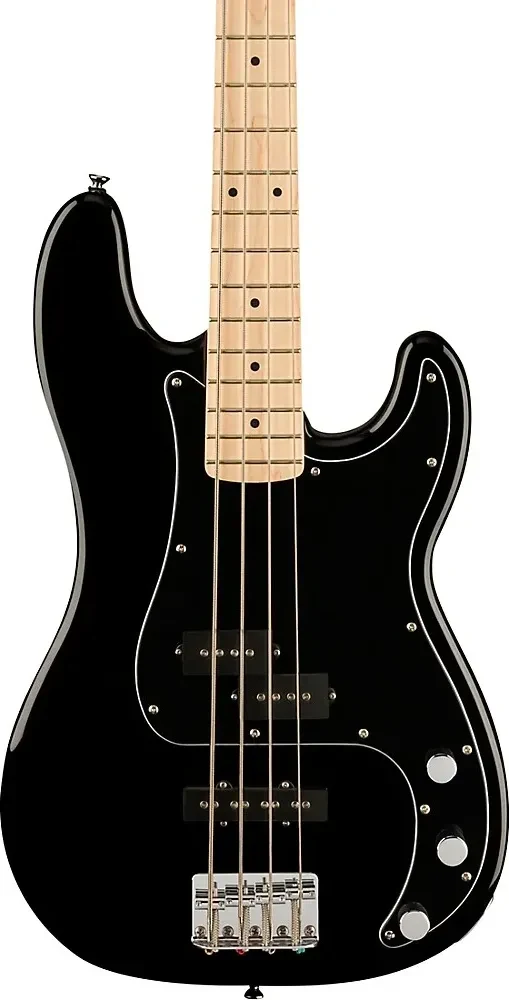
A PJ bass, such as the Squier Affinity Precision Bass PJ, has a P at the neck and a J at the bridge. The full guide is bass pickups explained.
Acoustic guitars use different pickups
An acoustic needs to sound like an acoustic, so its pickups work differently. Premier Guitar sets out the main families:
- Undersaddle piezo. A strip under the bridge saddle. It resists feedback at loud stage volumes but needs a preamp and EQ to tame a "quacky" sound.
- Soundhole magnetic. Much like an electric guitar pickup, clipped into the soundhole, with good gain before feedback.
- Body sensors. Sensors that pick up vibration from parts of the instrument, natural sounding but less resistant to feedback.
- Internal microphone. The most natural, and the most prone to feedback, so often blended with another type.
Many built-in systems blend two of these. The acoustics in the best acoustic guitars for beginners guide include models with and without electronics.
Choose by the route first, then the sound
The cavity in the body decides what fits without woodwork: a single-coil route takes a single coil, a rail or a stacked pickup; a humbucker route takes a humbucker or a humbucker-sized P-90; a P-90 route takes a P-90. Within that, choose by the music: single coils for clean sparkle, P-90s for raw bite, humbuckers for gain and silence. The best Stratocaster pickups and best humbuckers for a Les Paul guides narrow the choice, and how to change a pickup covers the swap.