A bass pickup works on exactly the same principle as a guitar pickup: a magnet, a coil of fine wire and a steel string whose movement changes the magnetic field through the coil. What differs is the job. Bass strings are heavier, wider apart and move further, and the range that matters runs much lower, so bass pickups have their own designs, shapes and names. For the underlying physics, start with how guitar pickups work.
The P pickup: one bass, two half-coils
Fender's Precision Bass appeared in 1951 with a simple single-coil pickup, essentially a four-pole version of Fender's guitar pickups, which hummed and gave an uneven volume across the strings. Fender replaced it with the split-coil pickup still used today; MusicRadar dates the change to 1957.
The P pickup has two short coils, offset from each other. Seymour Duncan explains that the halves are reverse wound with reverse polarity, so together they cancel hum in the same way as a guitar humbucker.
Seymour Duncan describes the P sound as midrange-forward and full, with a massive low end and clear attack through the mids and highs. The pickup sits under a strong point of the string's vibration in what is usually called the neck position, and Seymour Duncan notes that moving it far either way quickly spoils the tone. DiMarzio says its own P-style pickup cuts through a band without losing the bottom end.
The J pickup: two single coils that work as a pair
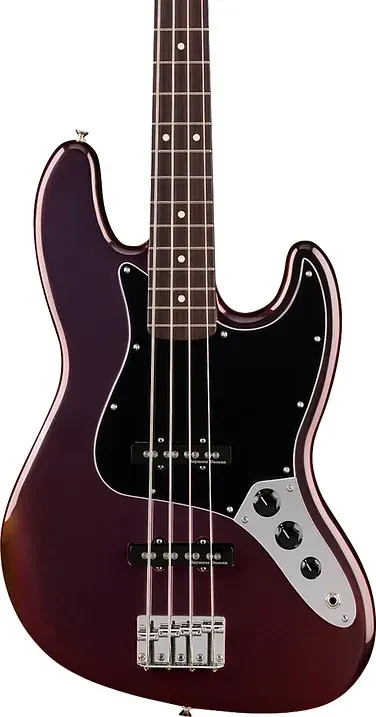
The Jazz Bass followed in 1960 with two narrow single-coil pickups, one near the neck and one near the bridge. Each pickup hums on its own. The two are reverse wound with reverse polarity, though, so with both turned fully up they cancel hum.
With both pickups on, the result is the present, slightly scooped Jazz Bass sound, which still has plenty of low end. Soloed, the neck pickup can sound close to a P pickup, while the bridge pickup adds punch, honk and detail. Seymour Duncan notes that Fender moved the bridge pickup even closer to the bridge in the 1970s.
A Jazz Bass usually has two volume controls and one tone, so you blend the pickups rather than switch between them. See the reviews of the Fender Player II Jazz Bass and the Squier Classic Vibe '60s Jazz Bass.
PJ: a P at the neck and a J at the bridge
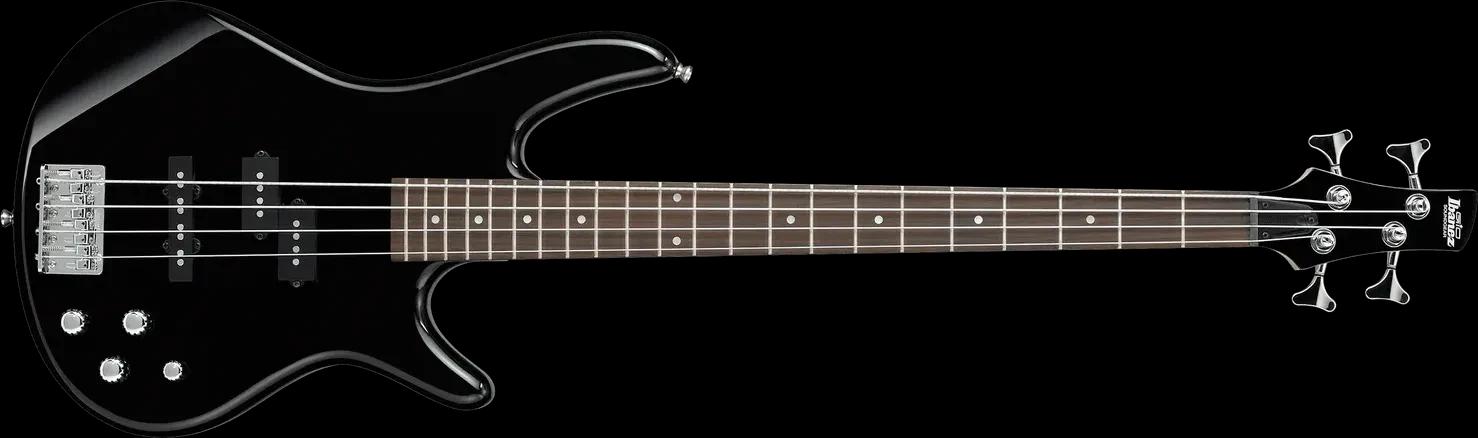
A PJ bass combines a P pickup in the usual Precision position with a J pickup at the bridge. Solo the P and you have a Precision; add the J and you get more bite and definition. It is a common layout on beginner basses because it covers a lot of ground, and two of the starter basses reviewed here use it: the Squier Affinity Precision Bass PJ and the Ibanez GSR200.
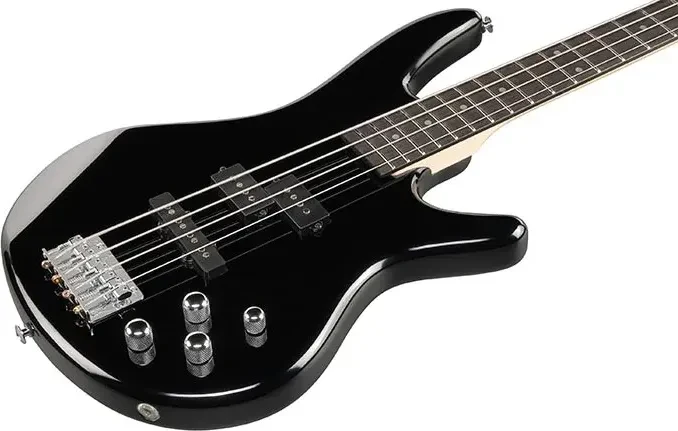
One caveat: the J pickup is a single coil, so soloing it brings back single-coil hum; only the P half of the pair cancels hum on its own.
The MusicMan humbucker: big poles near the bridge
Music Man's StingRay, launched in 1976, put a single large humbucker well back towards the bridge. Seymour Duncan's history of the pickup notes two things that make it unusual. Its coils are traditionally wired in parallel, where nearly all other humbuckers use series. And it was paired with a battery-powered preamp; Seymour Duncan calls the StingRay the first production active bass.
Placed near the bridge, the pickup adds even more punch to that full-yet-scooped voice. The MM-style pickup, with its very large pole pieces, has been copied and reworked many times and is found on many basses besides Music Man's; Music Man's own five-string StingRay added a switch for series, parallel and single-coil modes.
A soapbar describes the housing, not the coil
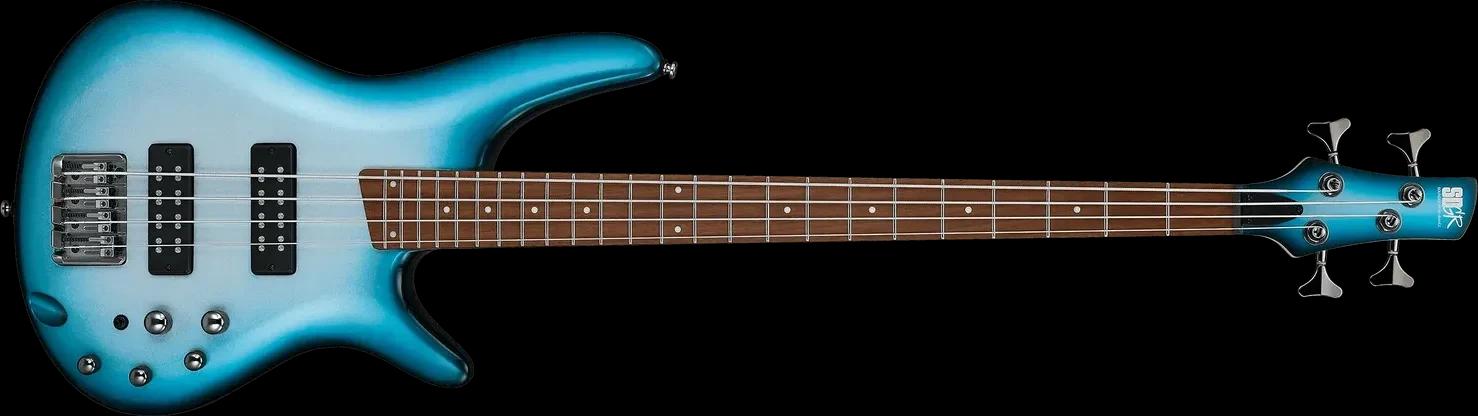
Many modern basses use rectangular "soapbar" pickups. The name describes the housing, and what is inside varies from maker to maker. The Ibanez SR300E, for example, uses a pair of Ibanez PowerSpan dual-coil pickups, with a switch that also taps them for a single-coil sound.
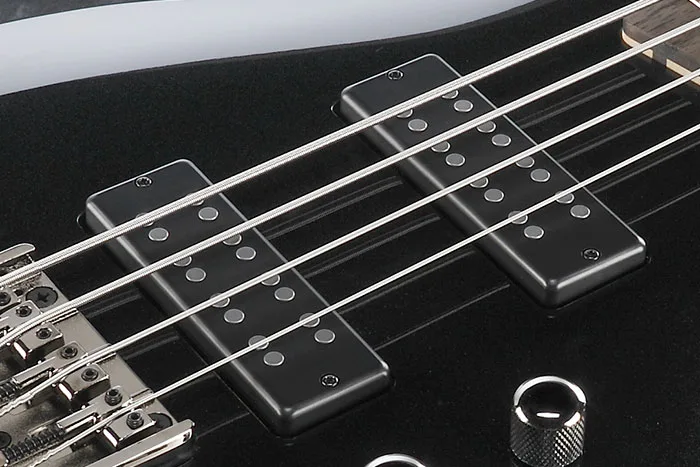
Because the cover hides the layout, read the maker's description to know what a soapbar actually is before you buy a replacement.
Active bass electronics come in two forms
Active electronics have been part of bass design since Music Man's StingRay. There are two different things the word can mean:
- Active pickups, where the preamp is built into the pickup itself.
- Active EQ or an onboard preamp, which can be fitted with passive pickups and adds boost and cut for bass, treble and often middle.
Either needs a battery, and active pickups normally use lower-value pots (Seymour Duncan lists 25k or 100k) than passive ones. Some basses with active EQ add an active/passive switch, as Yamaha's TRBX500 and TRBX600 models do, so the bass keeps working in passive mode. Several of the basses reviewed here have onboard EQ, among them the Ibanez SR300E, with a three-band EQ, and the Yamaha TRBX304, whose passive pickups feed an active circuit with Yamaha's Performance EQ switch; the active vs passive pickups guide covers the trade-offs in more detail.
Each layout suits a different sound
- For a classic, solid low end that sits in a mix: a P pickup.
- For punch, detail and a scooped blend: two J pickups.
- For range on one instrument: PJ, or a pair of dual-coil soapbars.
- For punch and a modern, scooped voice: an MM-style humbucker.
When upgrading, the route in the body decides what fits: a P route takes a P pickup, a J route a J pickup, and soapbar routes come in several sizes, so measure before ordering. Check whether you need a four- or five-string pickup, and whether the replacement is passive or needs a battery. The basic soldering and fitting steps are the same as for a guitar; see how to change a pickup and how to set pickup height.